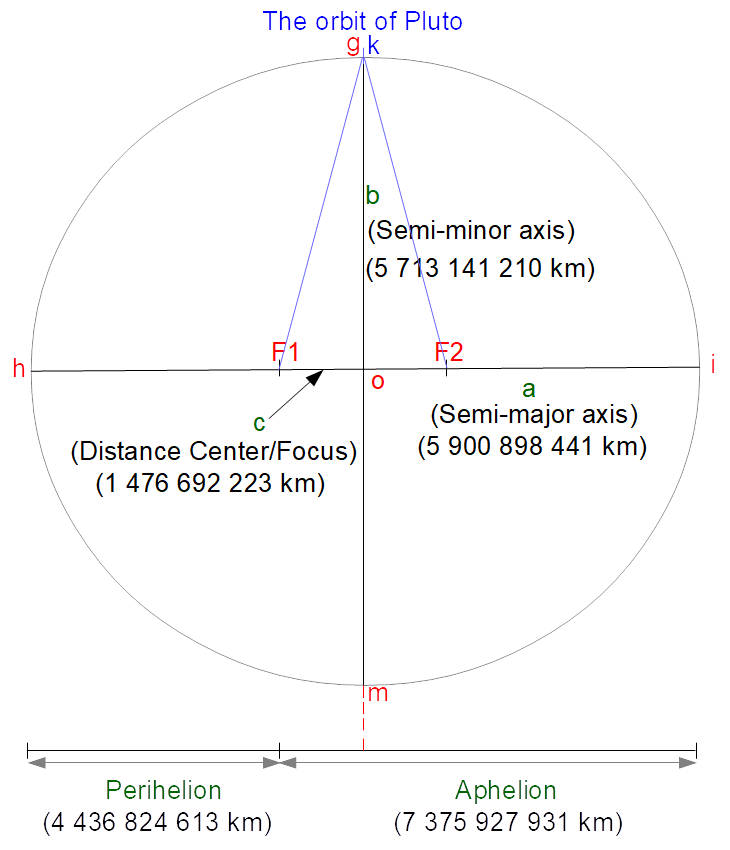
How to calculate the aphelion or the perihelion of the planetary body on the basis of the semi-major axis and on the basis of the eccentricity ?
As Jahannes Kepler would have said, all planets move in elliptical orbits. The orbit of the Earth is not circular or is not a perfect circle. The shape of the orbit of the Earth like the orbit of all the planets of the Solar System represents an ellipse. The shape of the ellipse is based on 2 foci. The ellipse has a major axis and a minor axis. The axes cross the center of the ellipse. The foci are found on the major axis. The farther from the center the focus is, the more elongated the ellipse is. One of the two foci of the ellipse of the orbit of the planetary body around the Sun represents the barycenter of the system at the level of our star the Sun.
The level of elongation of the ellipse of the orbit of the planetary body is related to the eccentricity parameter. The eccentricity of the ellipse (noted e) is equal to the ratio between the distance from the barycenter of the system or the center of the ellipse to the focus where the Sun can be found (noted c) and the semi-major axis of the ellipse (noted a).
Hence, we have e = c / a.
Let's consider for example the ellipse of the orbit of the dwarf planet Pluto. The semi-major axis of the orbit of Pluto around the Sun represents 39.482 Astronomical Units (AU) and the eccentricity of the ellipse of the orbit of Pluto around the Sun represents 0.2488. From those parameters, a and e, one can deduce c that is to say the distance between the center of the ellipse and one of the foci. e = c / a or 0.2488 = c / 39.482. So, c = 0.2488 * 39.482 or c is about 9.82 Astronomical Units (AU). The distance between the center of the ellipse of the orbit and the barycenter where the Sun can be found represents approximately 9.82 Astronomical Units (or about 1.47 billion kilometers).
The shortest distance between the planetary body and the focus or the barycenter where the Sun can be found is called the periapsis. In contrast, the farthest distance between the planetary body and the barycenter where the Sun can be found is called the apoapsis. The periapsis and the apoapsis are found on each side of the major axis of the ellipse of the orbit.
The periapsis or the shortest distance between the planetary body and the barycenter of the system represents the difference between the semi-major axis and the distance between the center of the ellipse and the focus where the Sun can be found. We have the periapsis p = a - c.
p = a - c. Thus p = 39.482 - 9.82 or p = 29.66 Astronomical Units (or about 4.437 billion kilometers).
The apoapsis or the farthest distance between the planetary body and the barycenter of the system represents the sum of the semi-major axis and of the distance from the center of the ellipse of the orbit to the focus where the Sun can be found. We have the apoapsis Apoapsis = a + c.
Apoapsis = a + c. Thus Apoapsis = 39.482 + 9.82 or Apoapsis = 49.3 Astronomical Units (or about 7.376 billion kilometers).
Let's keep in mind that the shortest distance between the planetary body and the barycenter of the Sun is not the semi-minor axis of the ellipse simply because the Sun is not at the center of the ellipse. At first sight, one could imagine that the semi-minor axis called b represents the shortest distance to the barycenter of the system but that's not the case obviously. In a perfect circle, the barycenter would appear in the center of the circle and the radius would be constant with no semi-major axis or no semi-minor axis.
Let's keep in mind that the eccentricity is not equal to the semi-minor axis divided by the semi-major axis. At first sight, one could have imagined that it is the way to calculate it but that's not the case. The eccentricity is the ratio between the distance from the center of the ellipse to the focus where the barycenter of the system can be found and the semi-major axis. e = c / a.
How can we calculate the semi-minor axis of the ellipse of the orbit ? One knows that in any position of the planetary body in the ellipse of the orbit, the sum of the distance of the planetary body to each focus is equal to the length of the major axis that is to say twice the length of the semi-major axis or 2a. What is the formula to calculate the semi-minor axis or b ? Let's imagine that the planetary body is found on top of the segment of the semi-minor axis at a point called k. In that case, the distance between the planetary body and the first focus is also equal to the distance between the planetary body and the second focus on the other side of the ellipse. We'll call the first focus F1 and the second focus F2. The distance from the planetary body to the first focus represents the segment k F1. By applying the Pythagorean theorem, one can say that the square of the length of the segment k F1 is equal to c² + b². Hence, we have (k F1)² = c² + b². Therefore, k F1 = (c² + b²)^(1/2). We know, by definition, that the sum of each length between the planetary body and each focus is equal to the length of the major axis that is to say 2a.
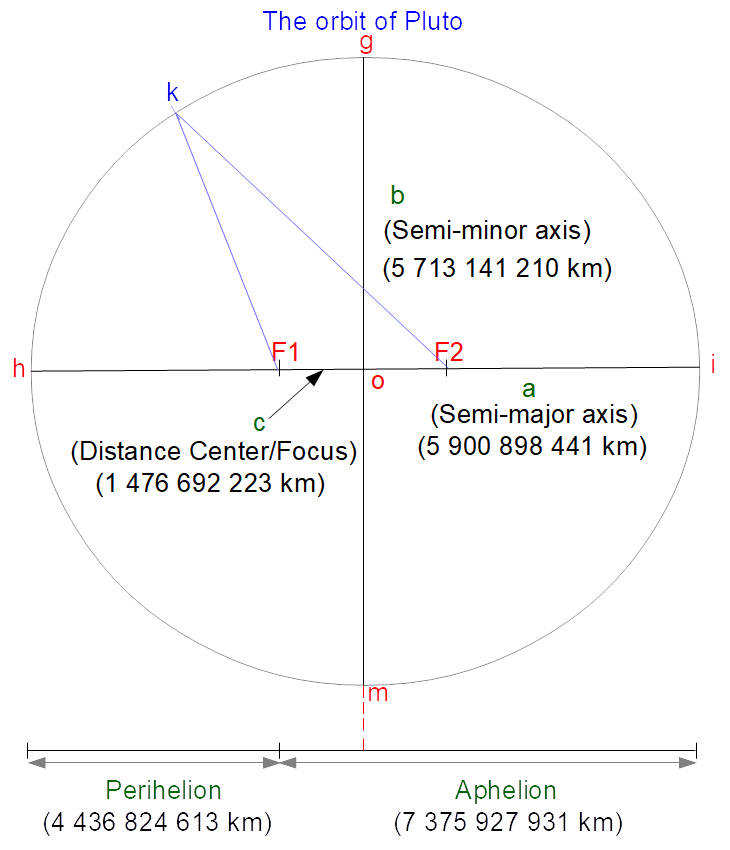
In the diagrams of the orbit of Pluto above, one can note that the point k represents the position of the planetary body in its orbit around the Sun. F1 represents the barycenter of the system where the Sun can be found. By definition, k F1 + k F2 is always equal to the major axis (or twice the semi-major axis). If the position of k is at the same position as g, one can notice that two similar triangles appear with a right angle at the level of the center o. The first triangle is k F1 o and the second triangle is k F2 o. One can apply the Pythagorean theorem to deduce the length of the semi-minor axis b.
One can write 2 * k F1 = 2a or 2 * (c² + b²)^(1/2) = 2a.
Therefore a = (c² + b²)^(1/2).
a² = c² + b²
b² = a² - c²
b = (a² - c²)^(1/2)
Thus, one can say that the semi-minor axis represents the square root of the difference between the square of the semi-major axis and the square of the distance from the center of the ellipse to the focus where the barycenter can be found.
What is the length of the semi-minor axis of the ellipse of the orbit of Pluto ? Let's apply the formula ! b = (a² - c²)^(1/2).
b = (39.482² - 9.82²)^(1/2)
b = 38.24 Astronomical Units (or about 5.721 kilometers).
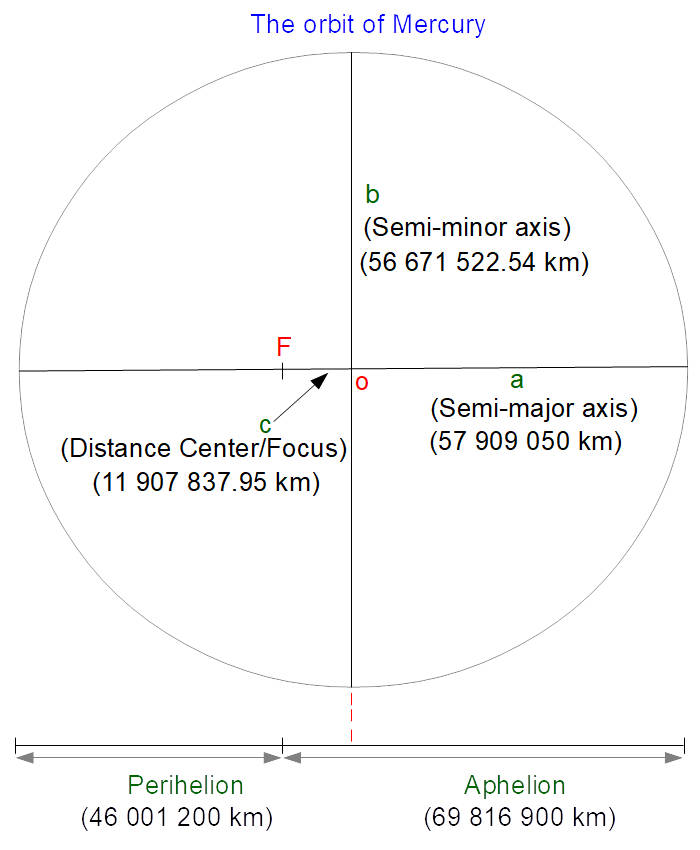
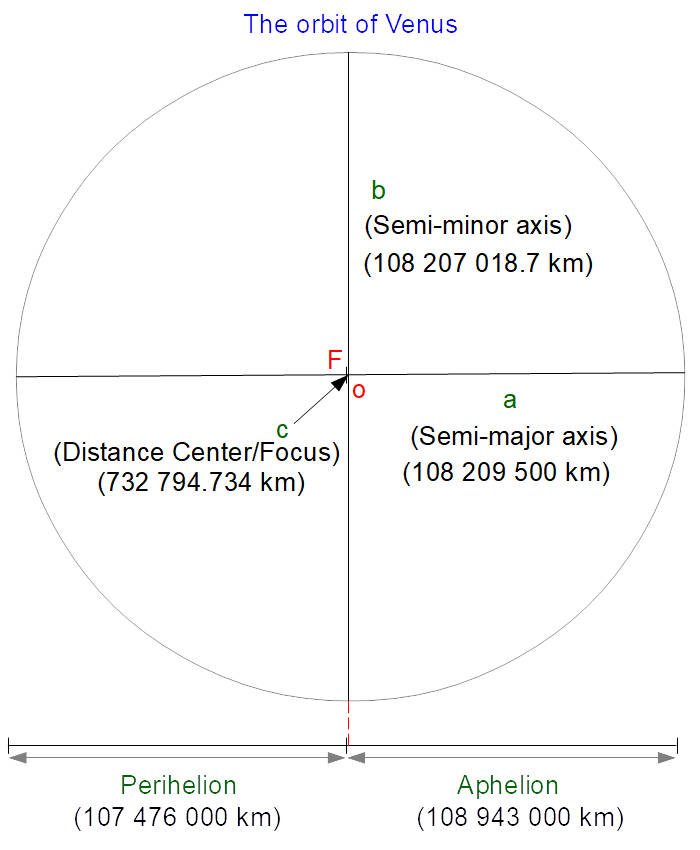
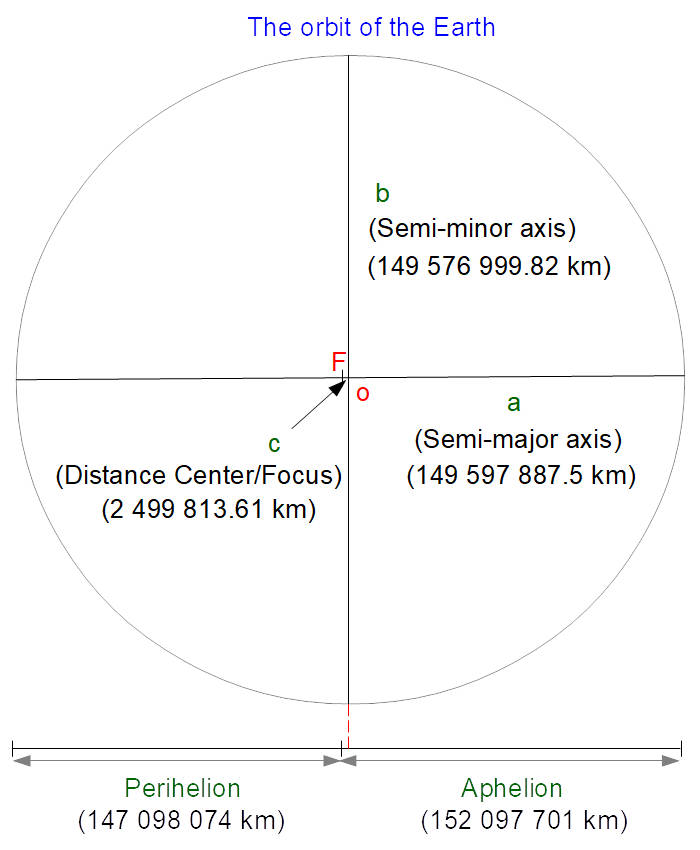
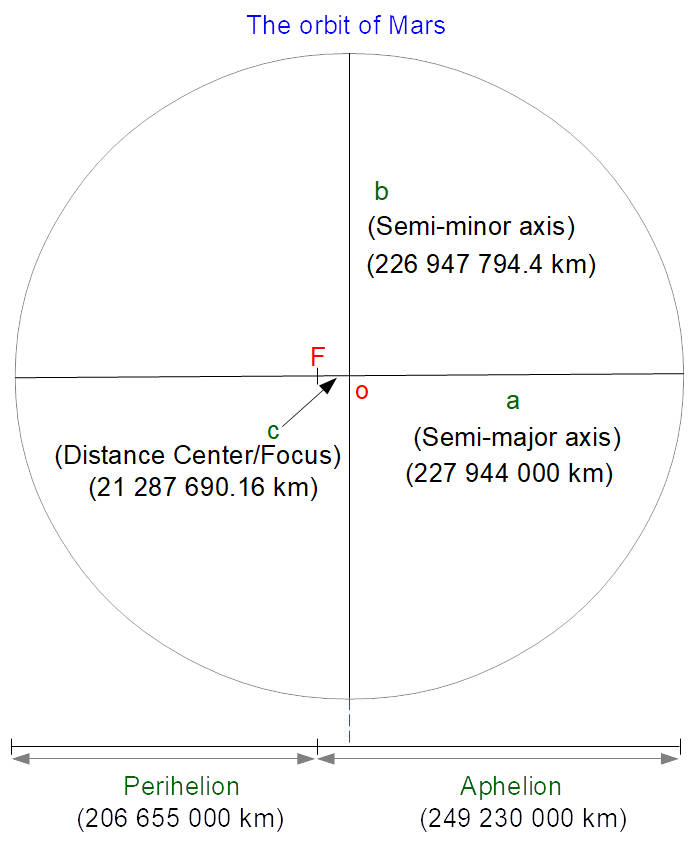
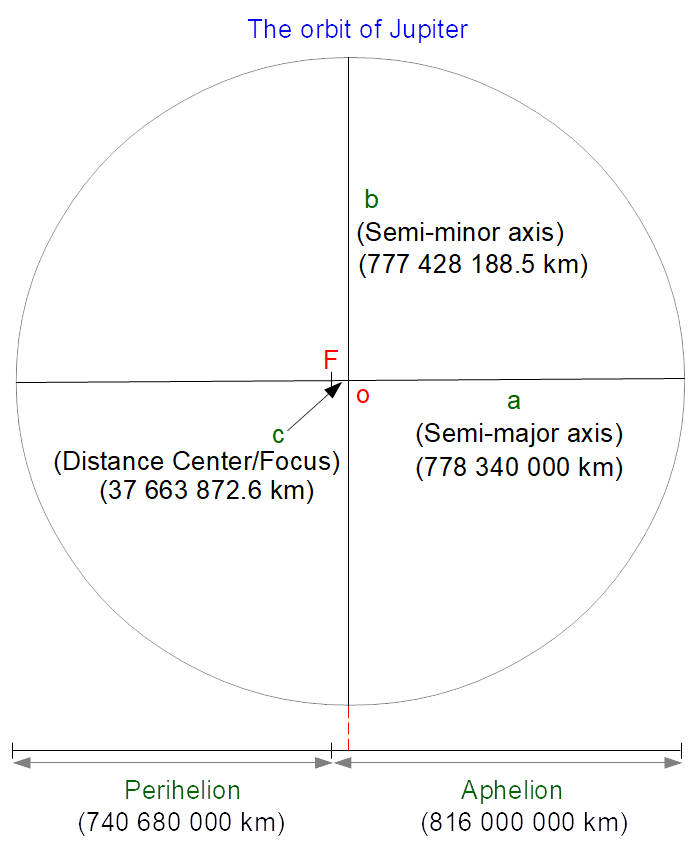
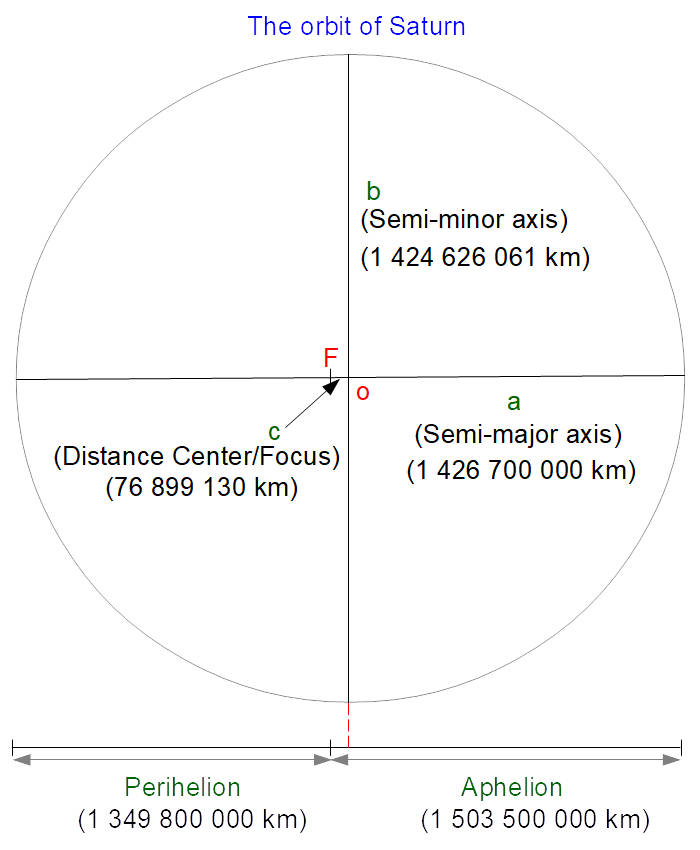
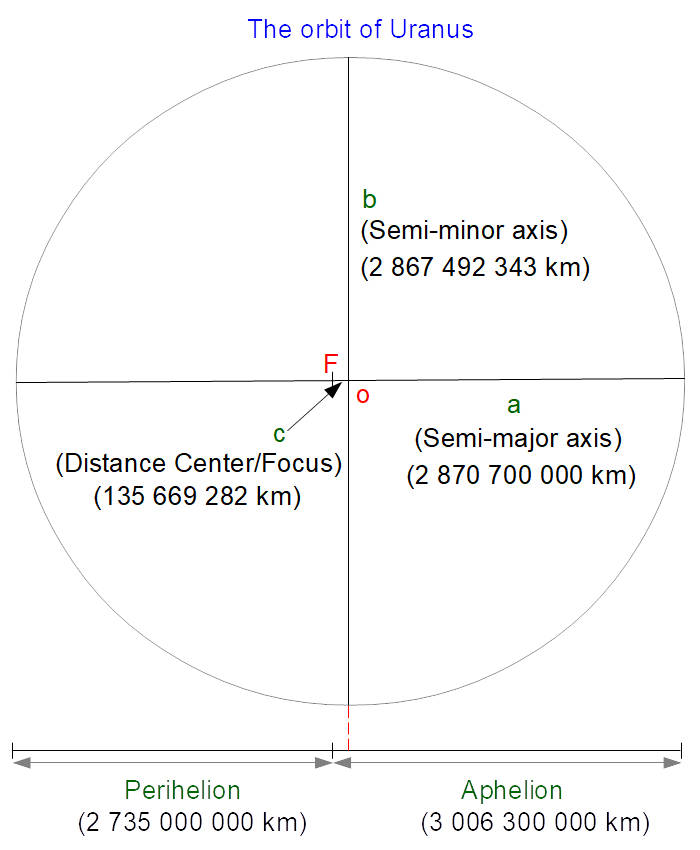
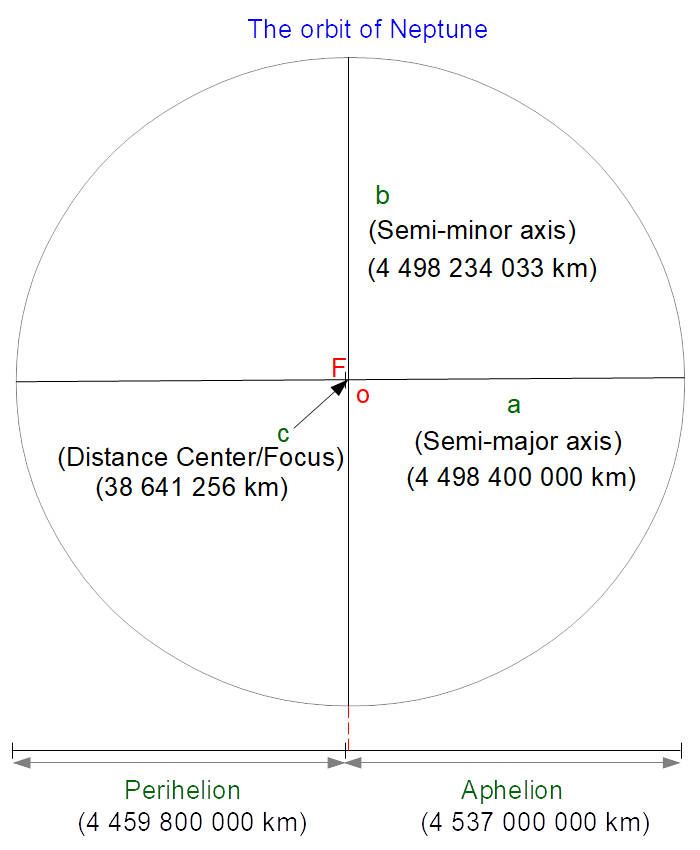
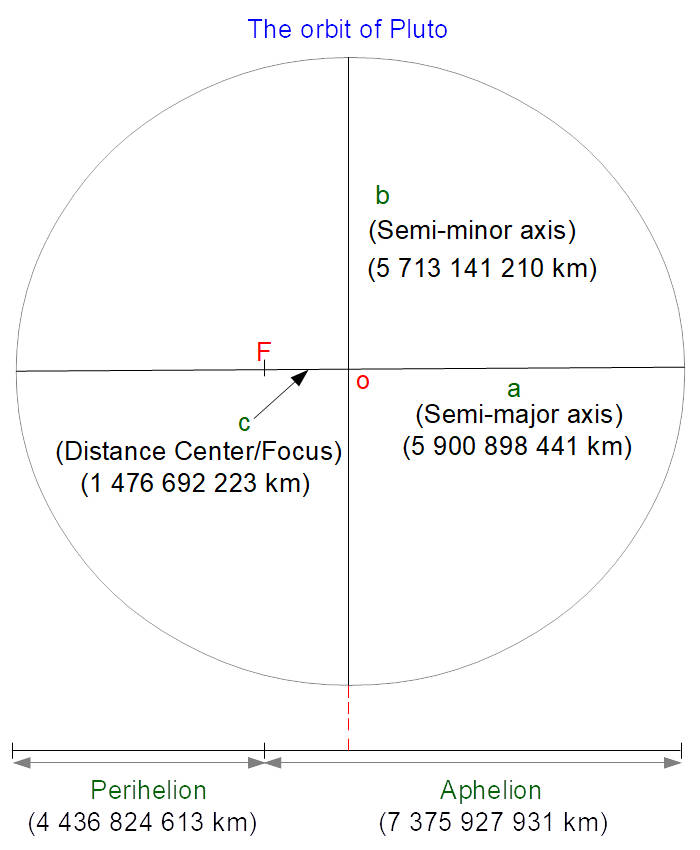
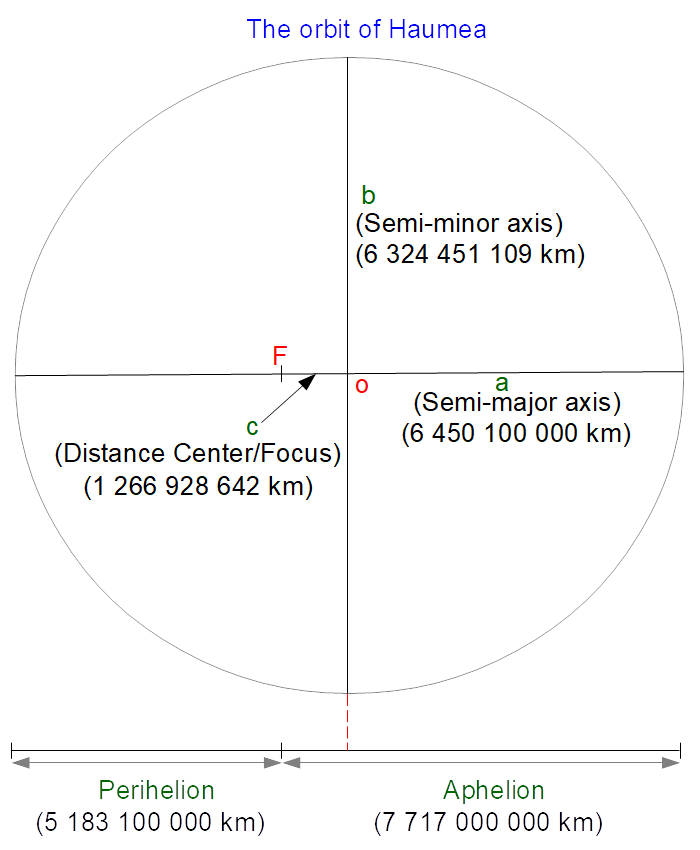
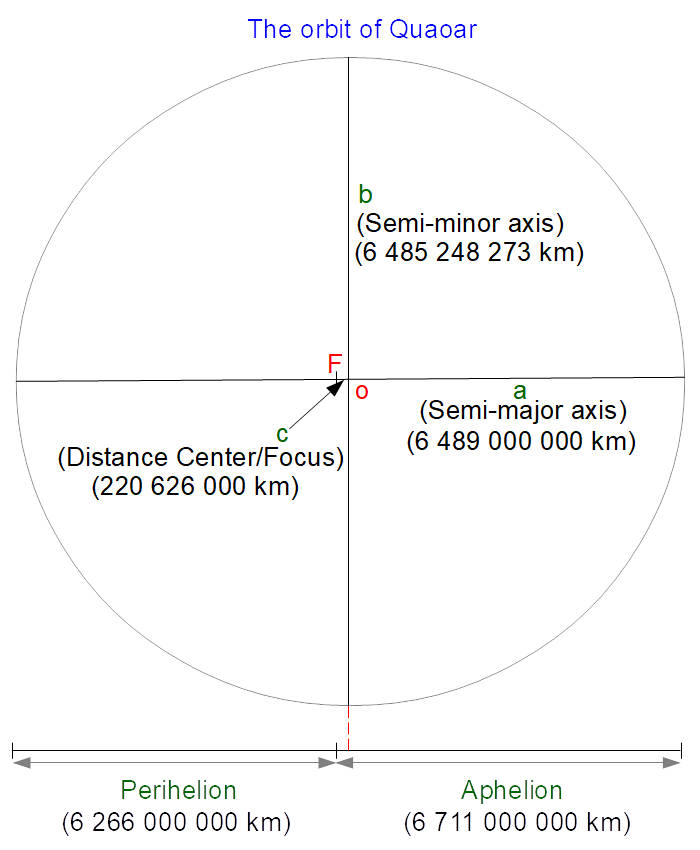
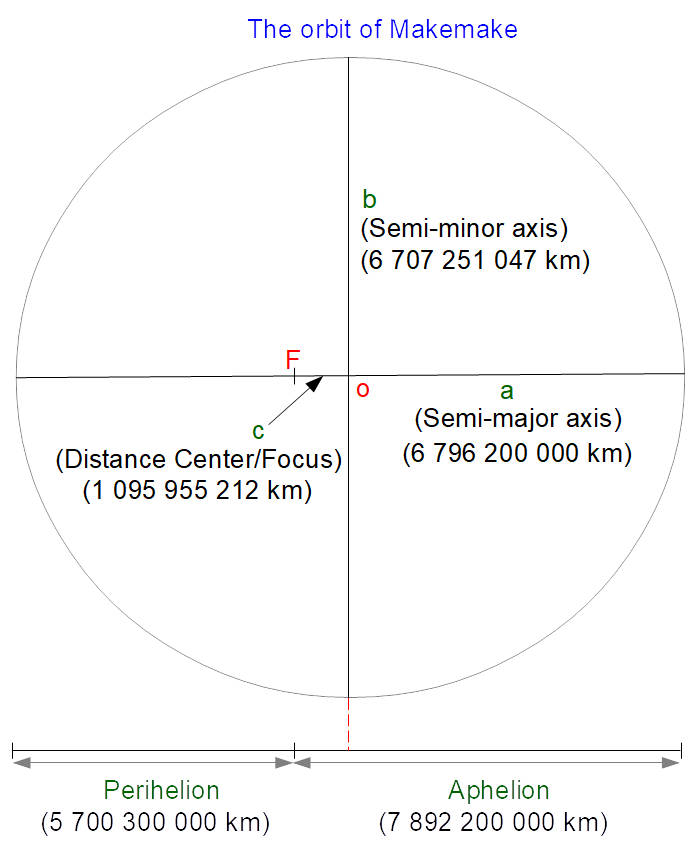
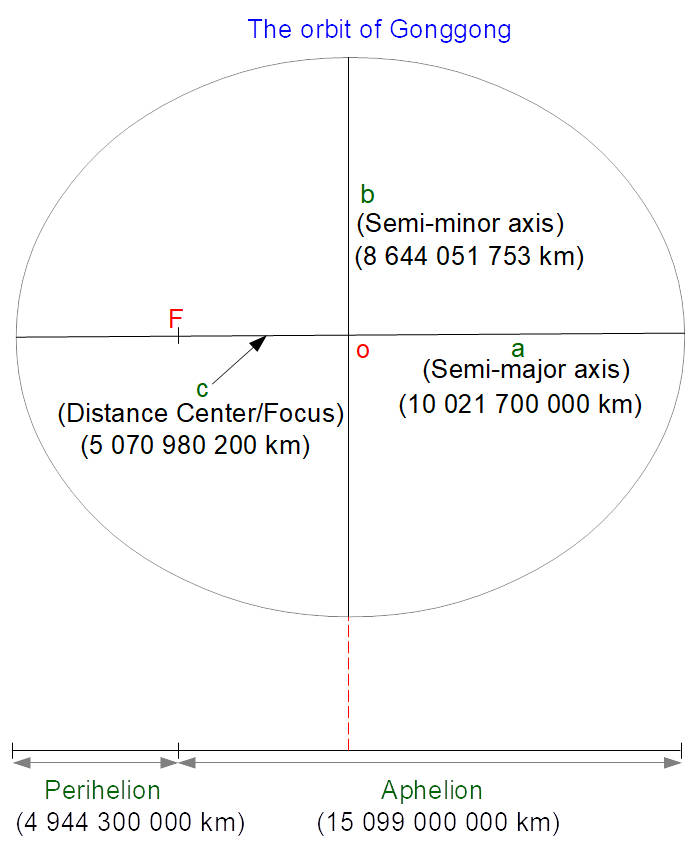
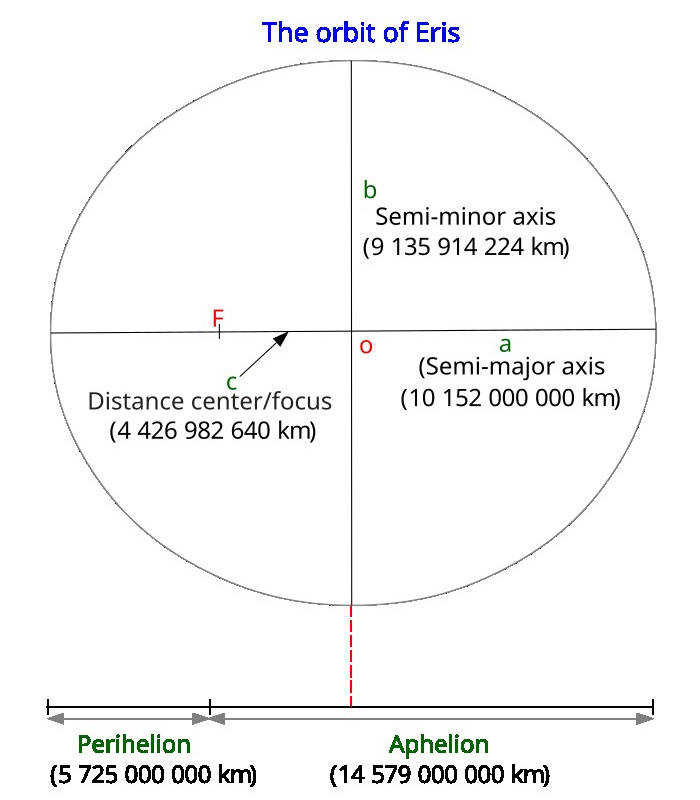
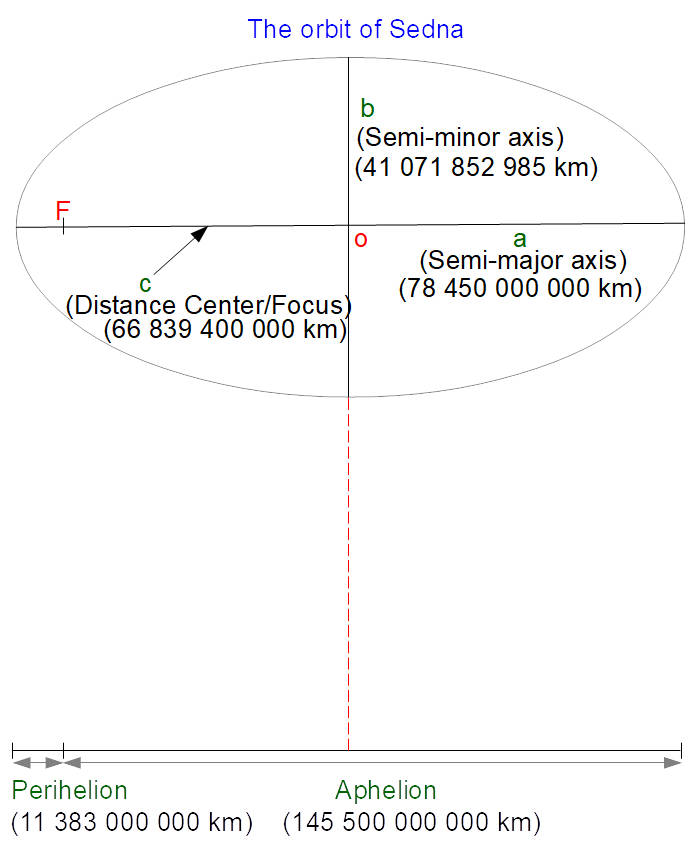
The table below reveals the semi-major axis and the eccentricity of major planetary bodies of the Solar System from planets to dwarf planets, from the nearest planetary body to the Sun to the farthest planetary body to our star.
| Planetary body | Semi-major axis in AU* | Eccentricity |
|---|---|---|
| Mercury | 0.387098 | 0.205630 |
| Venus | 0.723332 | 0.006772 |
| The Earth | 1.000 | 0.0167086 |
| Mars | 1.52368055 | 0.0934 |
| Jupiter | 5.2038 | 0.0489 |
| Saturn | 9.5826 | 0.0565 |
| Uranus | 19.19126 | 0.04717 |
| Neptune | 30.07 | 0.008678 |
| Pluto | 39.482 | 0.2488 |
| Haumea | 43.116 | 0.19642 |
| Quaoar | 43.694 | 0.04106 |
| Makemake | 45.499 | 0.1604 |
| Gonggong | 66.895 | 0.50318 |
| Eris | 67.69 | 0.44 |
| Sedna | 506 | 0.8496 |
(*): The semi-major axis is expressed here in Astronomical Units. One Astronomical Unit represents 149 597 870.700 kilometers.
Credit for the diagrams:
Marc Lafferre, 2025/2026.
Credit for the work:
Marc Lafferre, 2026.
(Natural intelligence)