Infographics 2020

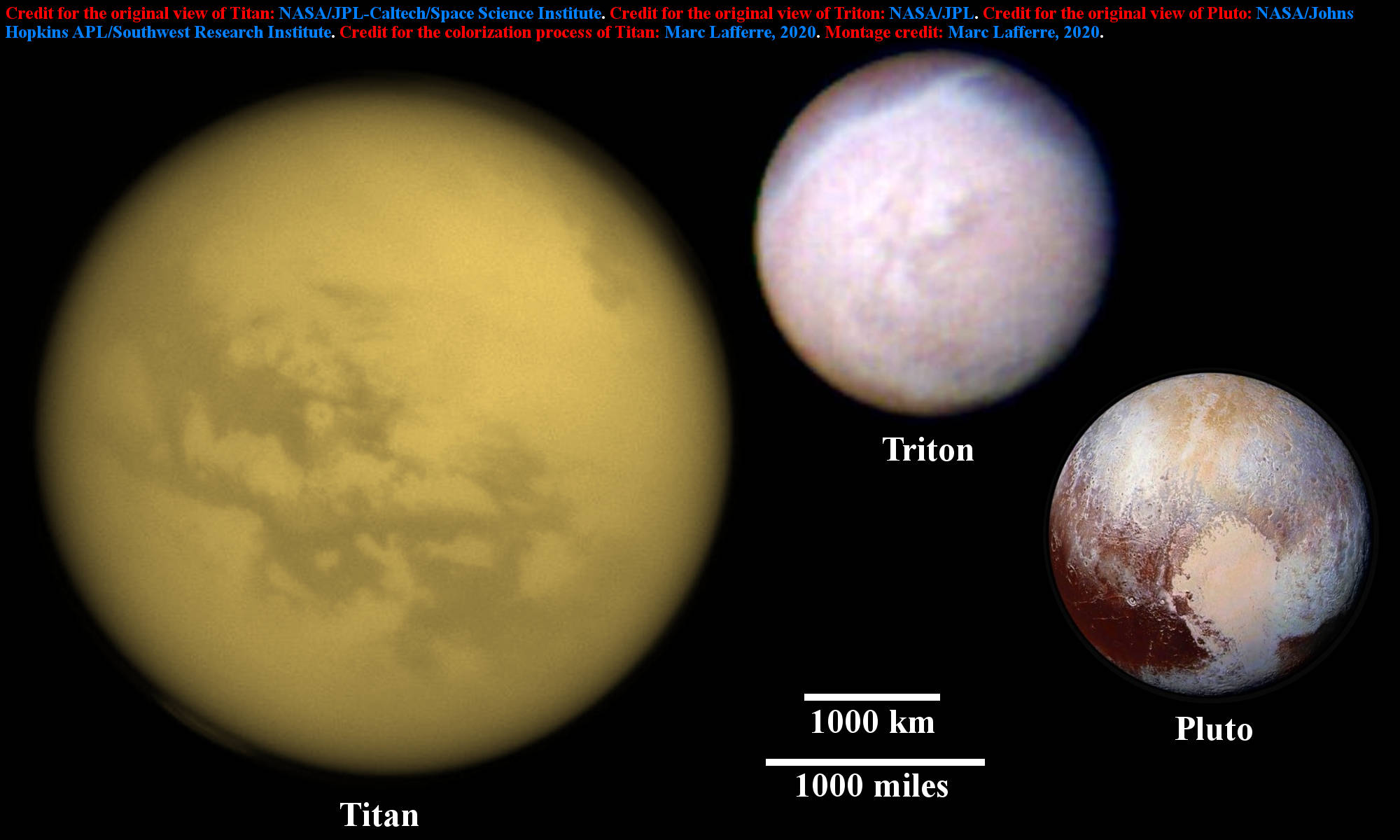
A composite view of Titan, Triton and Pluto at scale
A composite view of Titan, Triton and Pluto at scale 
    with notes. Credit for the original view of Titan: NASA/JPL-Caltech/Space Science Institute. Credit for the 
    original view of Triton: NASA/JPL. Credit for the original view of Pluto: NASA/Johns Hopkins APL/Southwest 
    Research Institute. Montage credit: Marc Lafferre, 202O.
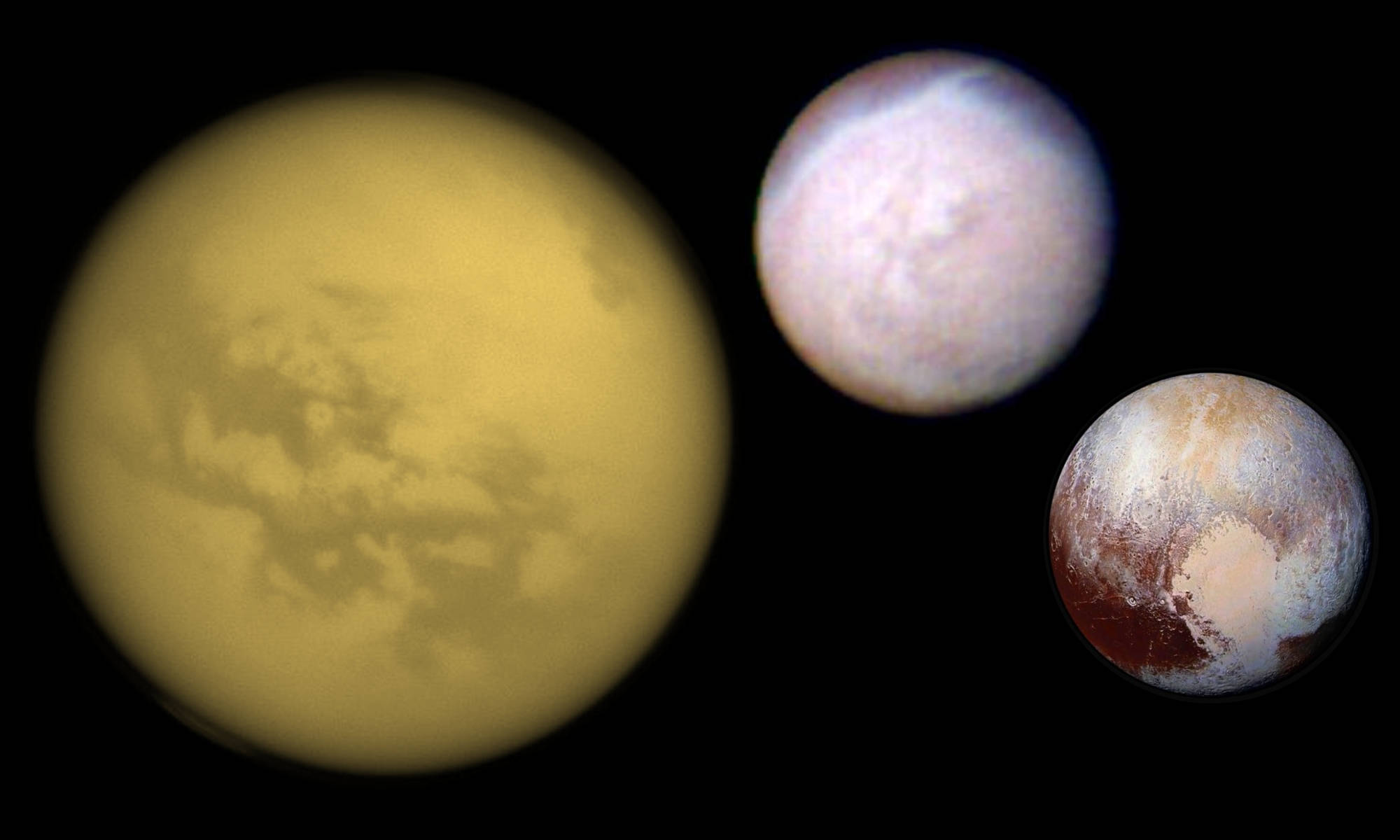
A composite view of Titan, Triton and Pluto at scale 
    without notes. Credit for the original view of Titan: NASA/JPL-Caltech/Space Science Institute. Credit for the 
    original view of Triton: NASA/JPL. Credit for the original view of Pluto: NASA/Johns Hopkins APL/Southwest 
    Research Institute. Montage credit: Marc Lafferre, 202O.

This composite view reveals Titan, Triton and Pluto at scale. Titan represents the largest moon of Saturn. Triton represents the largest moon of Neptune. Pluto represents the largest dwarf planet in the Solar System. The original view of Titan whose file name is PIA14663.jpg was obtained from the Cassini orbiter on April 13, 2013. The original view of Triton whose file name is PIA02211.jpg was obtained on August 22, 1989 from the Voyager 2 spacecraft. The original view of Pluto was acquired during the historic flyby of the system of Pluto and Charon performed by the New Horizons spacecraft on July 14, 2015. The colors of Titan in this view are artificial.

Credit for the original view of Titan: NASA/JPL-Caltech/Space Science Institute.
Credit for the original view of Triton: NASA/JPL.
Credit for the original view of Pluto: NASA/Johns Hopkins APL/Southwest Research Institute.
Montage credit: Marc Lafferre, 2020.
(Natural intelligence)
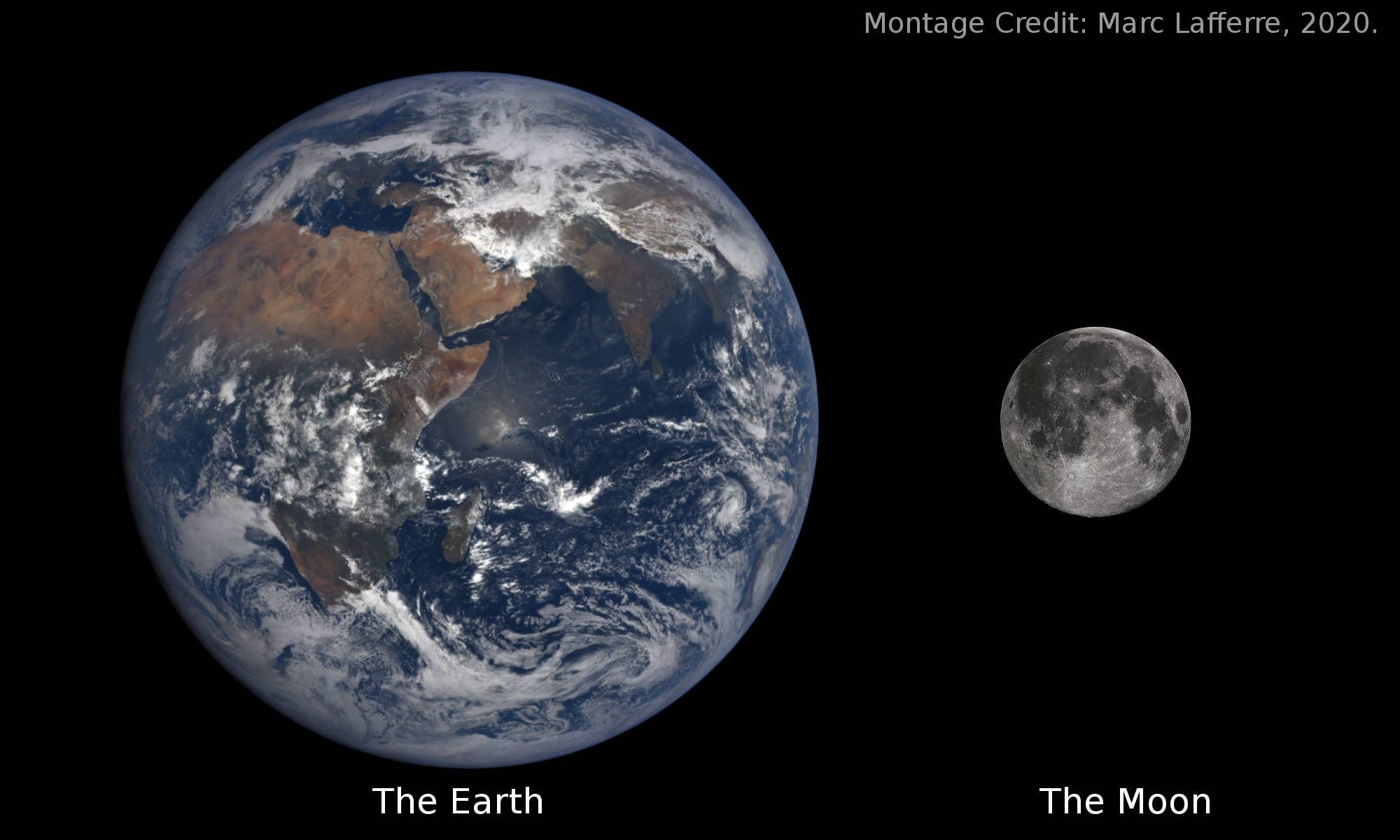
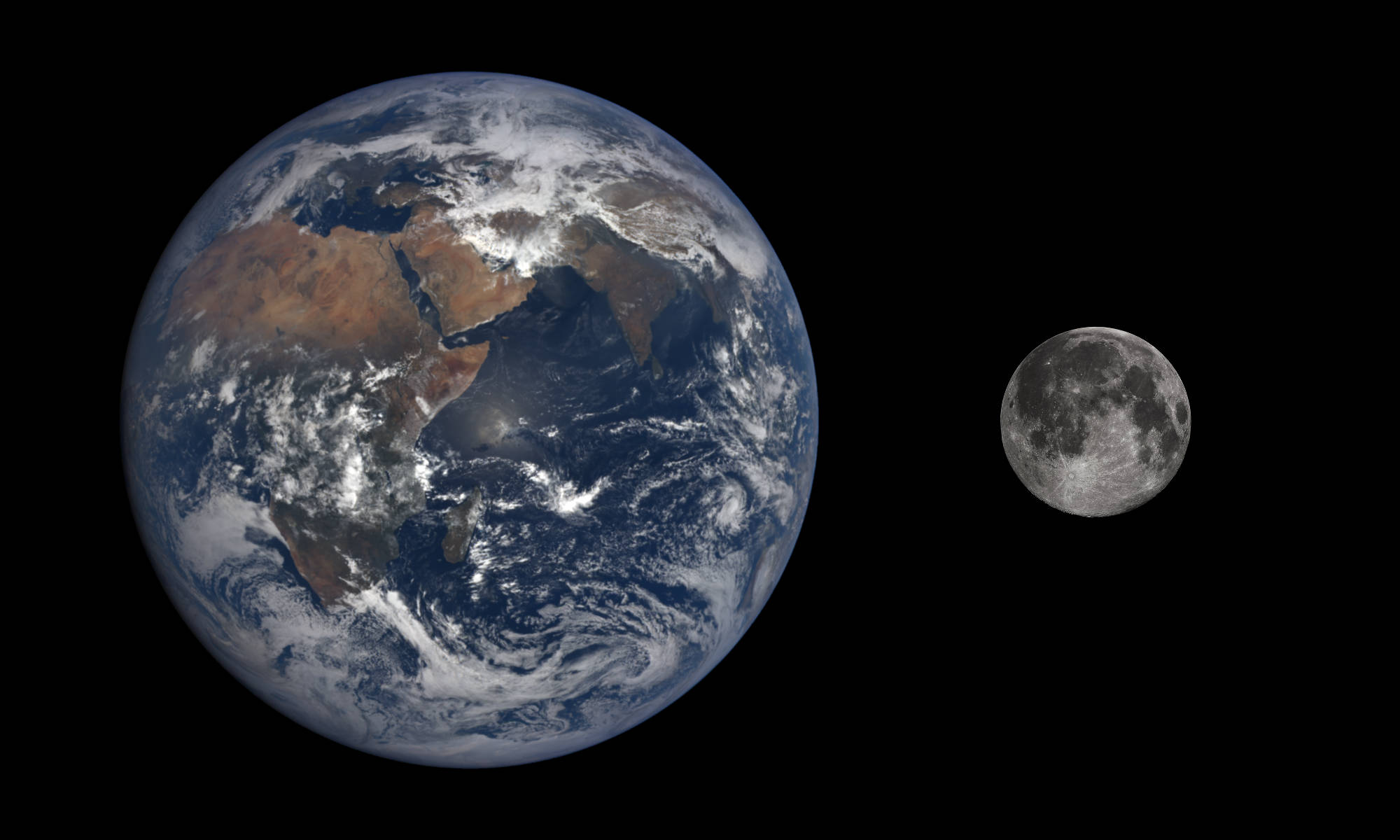
A composite view of the Earth and the Moon at scale
A composite view of the Earth and the Moon at scale with 
    notes. Credit for the original view of the Earth: NASA/DSCOVR/EPIC. Source and credit for the original view of 
    the Moon: Wikipedia/Gregory H. Revera (CC BY-SA 3.0). Montage credit: Marc Lafferre, 2020.
A composite view of the Earth and the Moon at scale 
    without notes. Credit for the original view of the Earth: NASA/DSCOVR/EPIC. Source and credit for the original 
    view of the Moon: Wikipedia/Gregory H. Revera (CC BY-SA 3.0). Montage credit: Marc Lafferre, 2020.

This composite view reveals the Earth and the Moon at scale. The original image of the Earth was acquired with the EPIC instrument of the DSCOVR spacecraft on March 24, 2017. The original image of the Moon was taken on October 22, 2010 by Gregory H. Revera. The Moon is much smaller than the Earth and may have formed from a disc of debris, dust or gases resulting from a collision between a planetary body whose size was roughly equivalent to the size of Mars and the "Proto-Earth".

Credit for the original view of the Earth: NASA/DSCOVR/EPIC.
Source and credit for the original view of the Moon: Wikipedia/Gregory H. Revera (CC BY-SA 3.0).
Montage credit: Marc Lafferre, 2020.
(Natural intelligence)
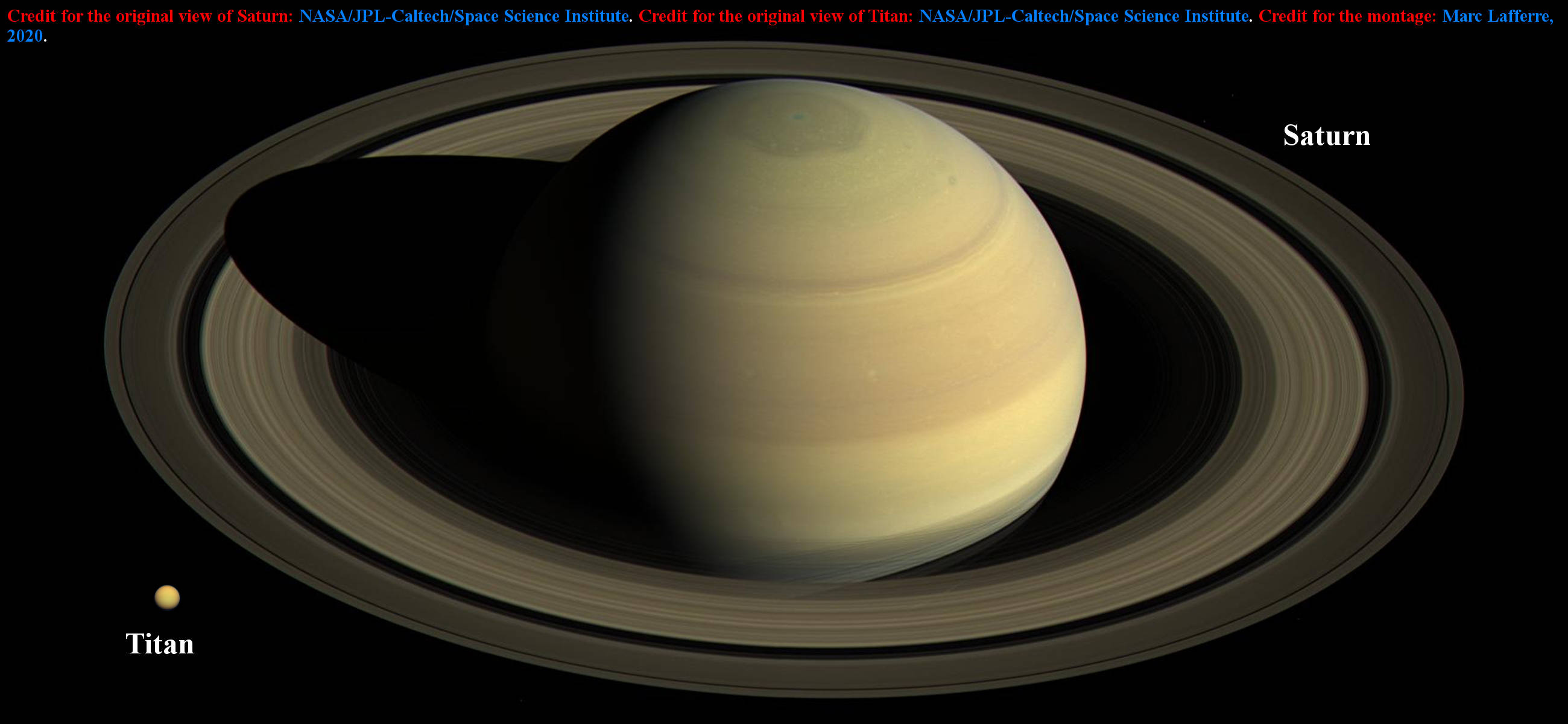
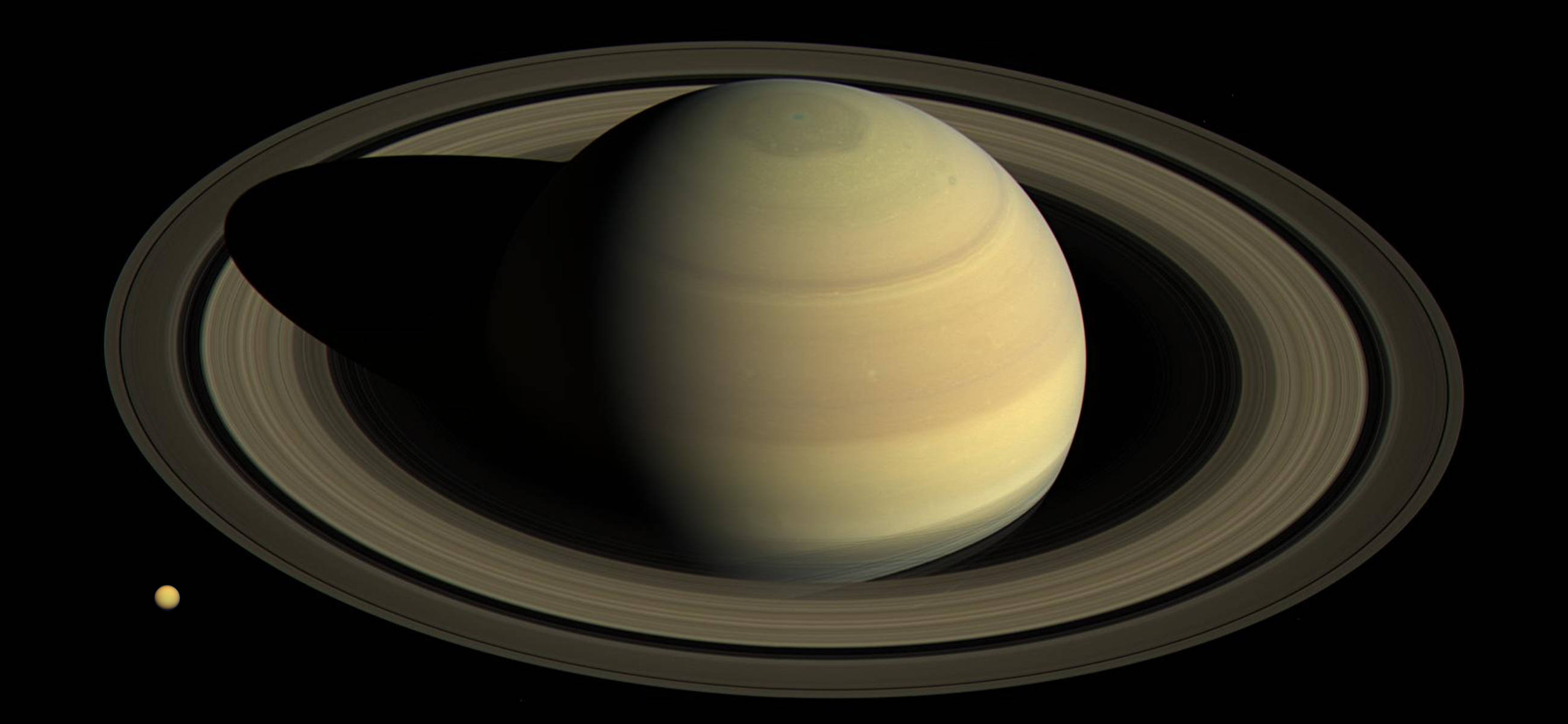
A composite view of Titan and Saturn unveiling its rings at scale
A composite view of Titan and Saturn unveiling its rings at 
    scale with notes. Credit for the original view of Titan: NASA/JPL-Caltech/Space Science Institute. Credit for 
    the original view of Saturn: NASA/JPL-Caltech/Space Science Institute. Montage credit: Marc Lafferre, 2020.
A composite view of Titan and Saturn unveiling its rings at 
    scale without notes. Credit for the original view of Titan: NASA/JPL-Caltech/Space Science Institute. Credit for 
    the original view of Saturn: NASA/JPL-Caltech/Space Science Institute. Montage credit: Marc Lafferre, 2020.

This composite view reveals Titan and Saturn unveiling its rings at scale. The original view of Titan whose file name is PIA14602.jpg was generated on the basis of data obtained from the Cassini spacecraft with the Wide-Angle Camera on January 30, 2012. The original view of Saturn whose file name is PIA21046.jpg was generated on the basis of data captured from the Cassini orbiter with the Wide-Angle Camera on April 25, 2016. Titan represents, by far, the largest moon of the gas giant Saturn.

Credit for the original view of Titan: NASA/JPL-Caltech/Space Science Institute.
Credit for the original view of Saturn: NASA/JPL-Caltech/Space Science Institute.
Montage credit: Marc Lafferre, 2020.
(Natural intelligence)
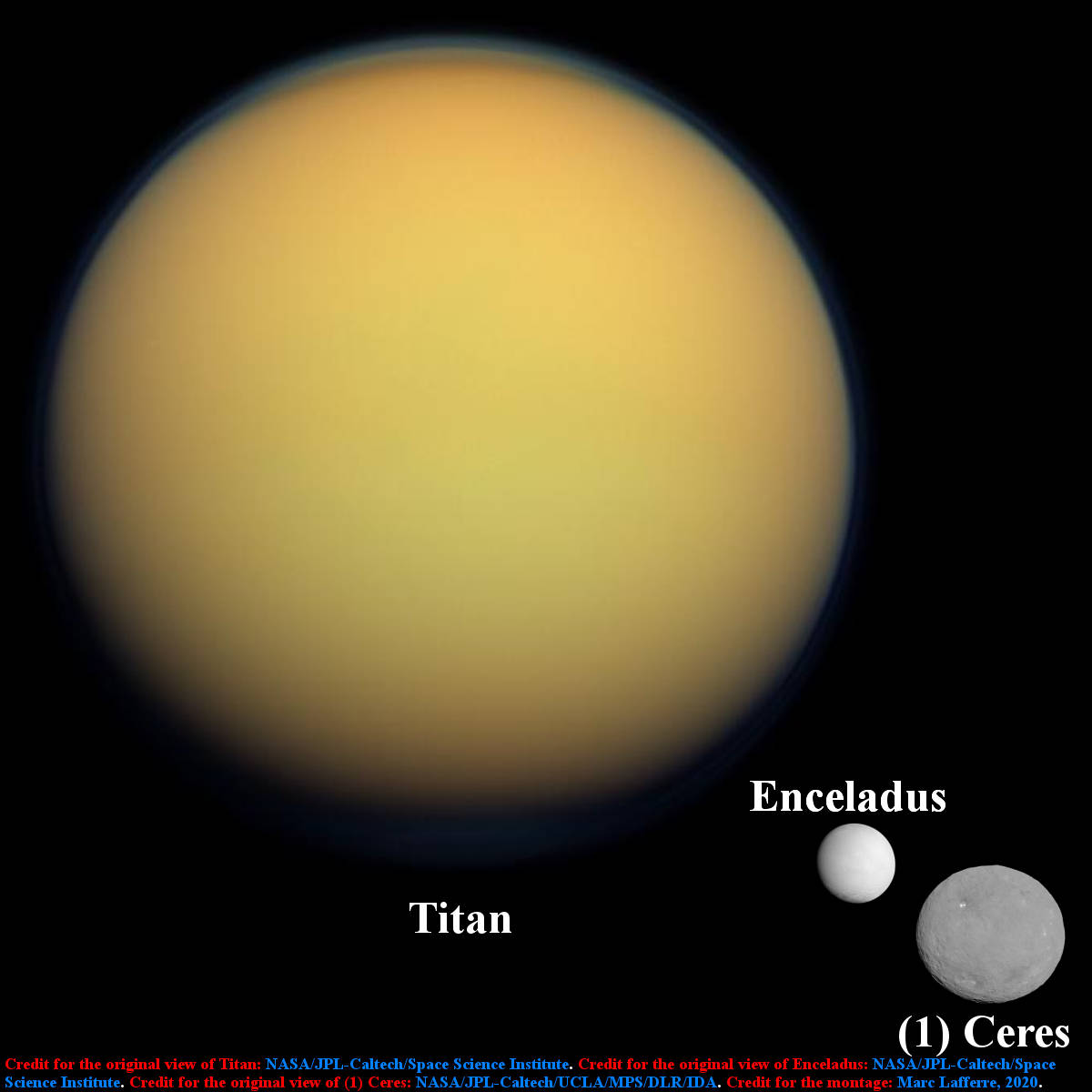
A composite view of Titan, Enceladus and Ceres at scale
A composite view of Titan, Enceladus and Ceres at 
    scale with notes. Credit for the original view of Titan: NASA/JPL-Caltech/Space Science Institute. Credit for 
    the original view of Enceladus: NASA/JPL-Caltech/Space Science Institute. Credit for the original view of Ceres: 
    NASA/JPL-Caltech/UCLA/MPS/DLR/IDA. Montage credit: Marc Lafferre, 2020.
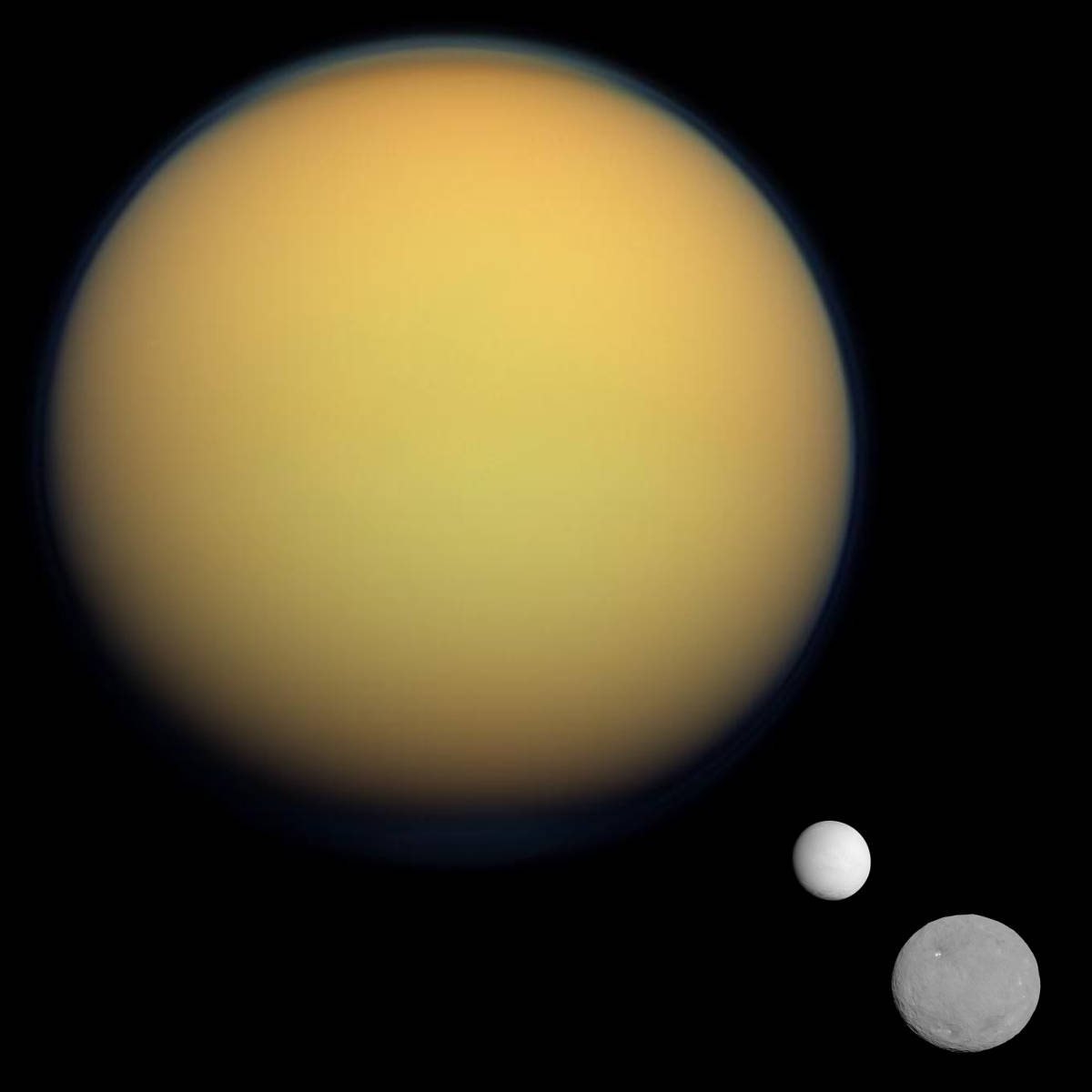
A composite view of Titan, Enceladus and Ceres at 
    scale without notes. Credit for the original view of Titan: NASA/JPL-Caltech/Space Science Institute. Credit for 
    the original view of Enceladus: NASA/JPL-Caltech/Space Science Institute. Credit for the original view of Ceres: 
    NASA/JPL-Caltech/UCLA/MPS/DLR/IDA. Montage credit: Marc Lafferre, 2020.

This composite view reveals Titan, Enceladus and Ceres at scale. The original view of Titan whose file name is PIA14602.jpg was produced on the basis of data acquired from the Cassini orbiter with the Wide-Angle Camera on January 30, 2012. The original view of Enceladus whose file name is PIA14588.jpg was obtained on November 6, 2011 with the Narrow-Angle Camera of the Cassini spacecraft. The original view of Ceres whose file name is PIA19562.jpg was acquired during a sequence of snapshots performed on May 5 and 6, 2015 from the Dawn spacecraft. Titan is much bigger than the icy moon Enceladus and than the dwarf planet Ceres.

Credit for the original view of Titan: NASA/JPL-Caltech/Space Science Institute.
Credit for the original view of Enceladus: NASA/JPL-Caltech/Space Science Institute.
Credit for the original view of Ceres: NASA/JPL-Caltech/UCLA/MPS/DLR/IDA.
Montage credit: Marc Lafferre, 2020.
(Natural intelligence)
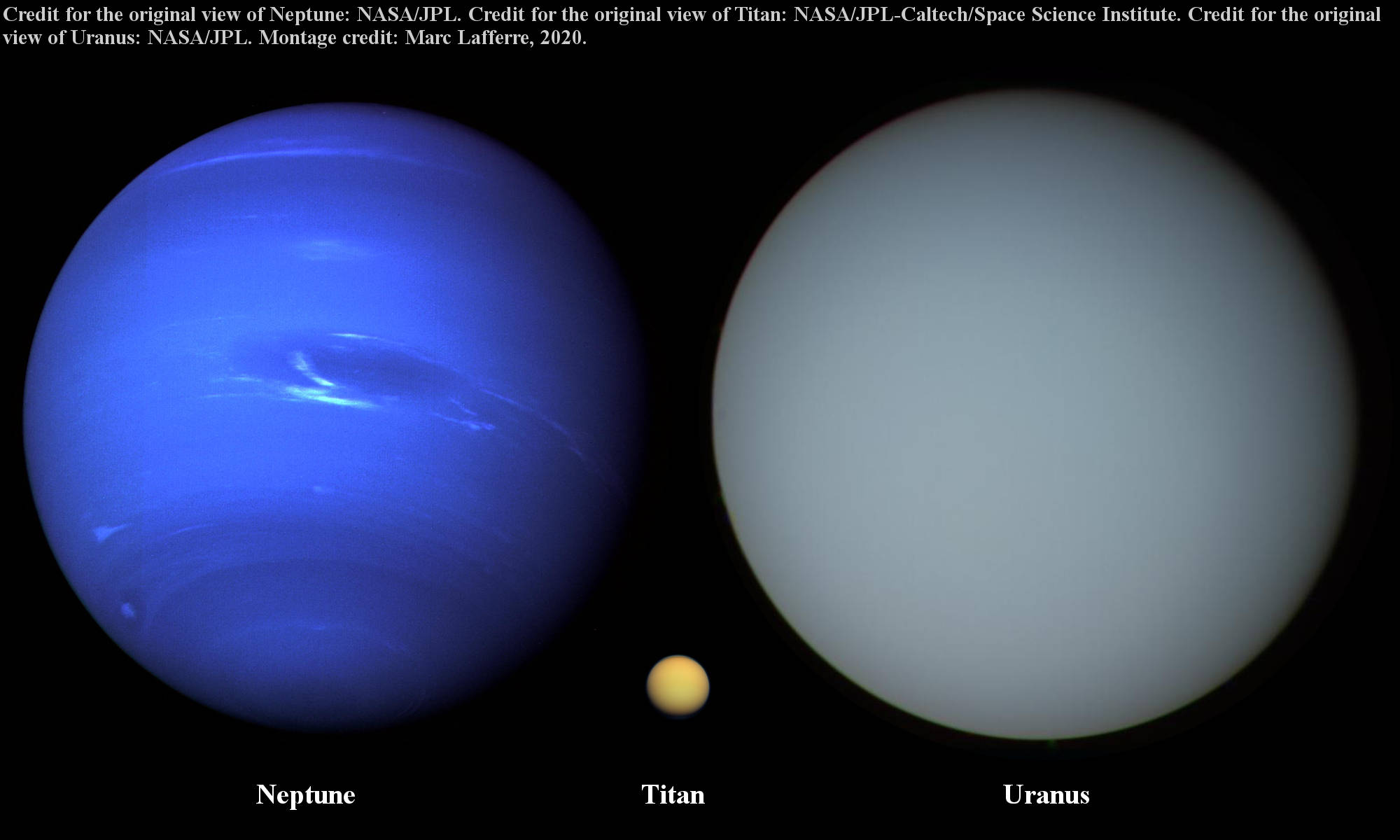
A composite view of Neptune, Titan and Uranus at scale
A composite view of Neptune, Titan and Uranus at 
    scale with notes. Credit for the original view of Neptune: NASA/JPL. Credit for the original view of Titan: 
    NASA/JPL-Caltech/Space Science Institute. Credit for the original view of Uranus: NASA/JPL. Montage credit: 
    Marc Lafferre, 2020.
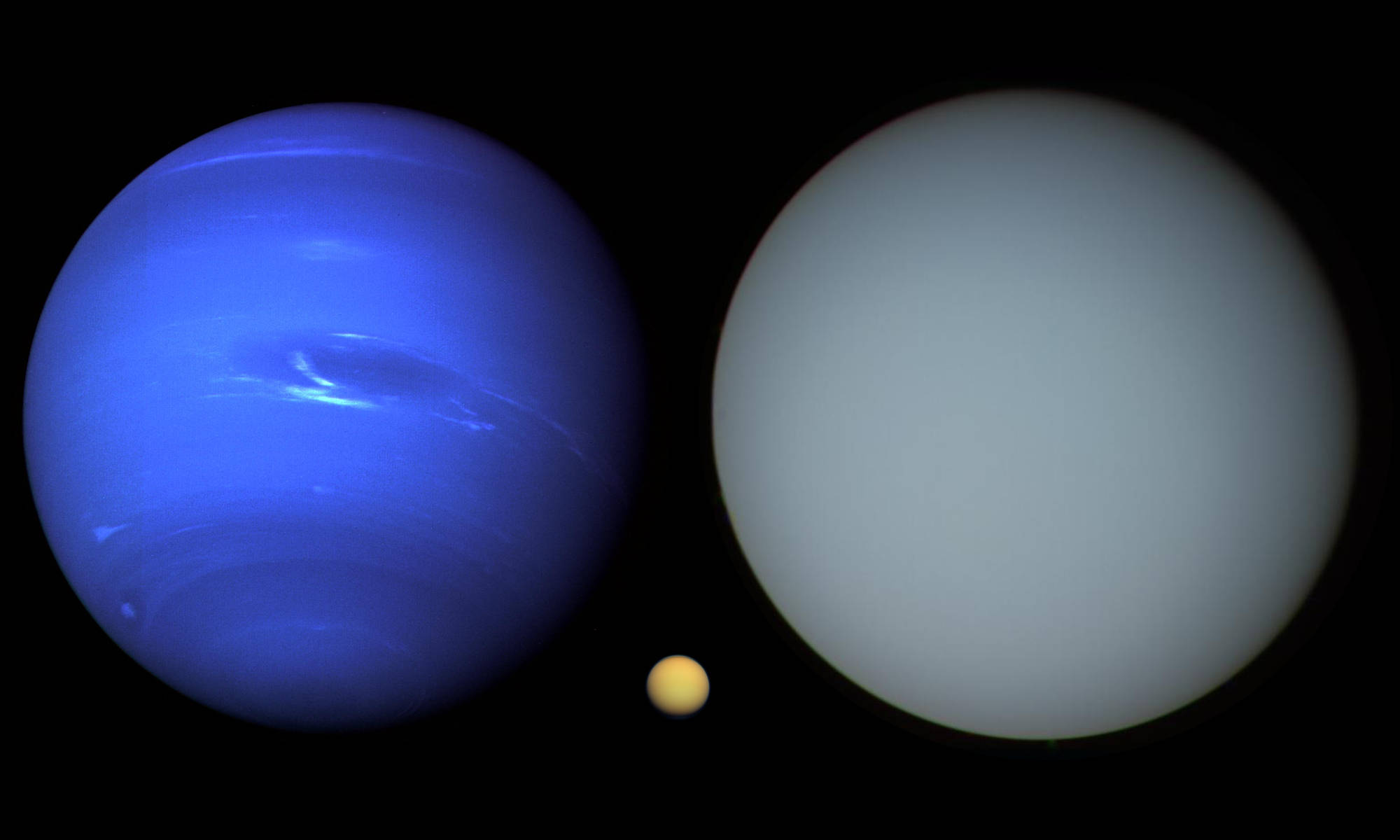
A composite view of Neptune, Titan and Uranus at 
    scale without notes. Credit for the original view of Neptune: NASA/JPL. Credit for the original view of Titan: 
    NASA/JPL-Caltech/Space Science Institute. Credit for the original view of Uranus: NASA/JPL. Montage credit: 
    Marc Lafferre, 2020.

This composite image reveals Neptune, Titan and Uranus at scale. Neptune is almost as big as Uranus and is much bigger than the largest moon of Saturn Titan. Neptune is more massive than Uranus thanks to a higher mean density. The views of Uranus and Neptune were obtained from the Voyager 2 spacecraft during its historic flybys of those gas giants or ice giants in 1986 for Uranus and in 1989 for Neptune. Titan appears relatively uniform from outer space in the visible spectrum like Uranus. The internal structure of gas giants or ice giants is a major topic of research.

Credit for the original view of Neptune: NASA/JPL.
Credit for the original view of Titan: NASA/JPL-Caltech/Space Science Institute.
Credit for the original view of Uranus: NASA/JPL.
Montage credit: Marc Lafferre, 2020.
(Natural intelligence)
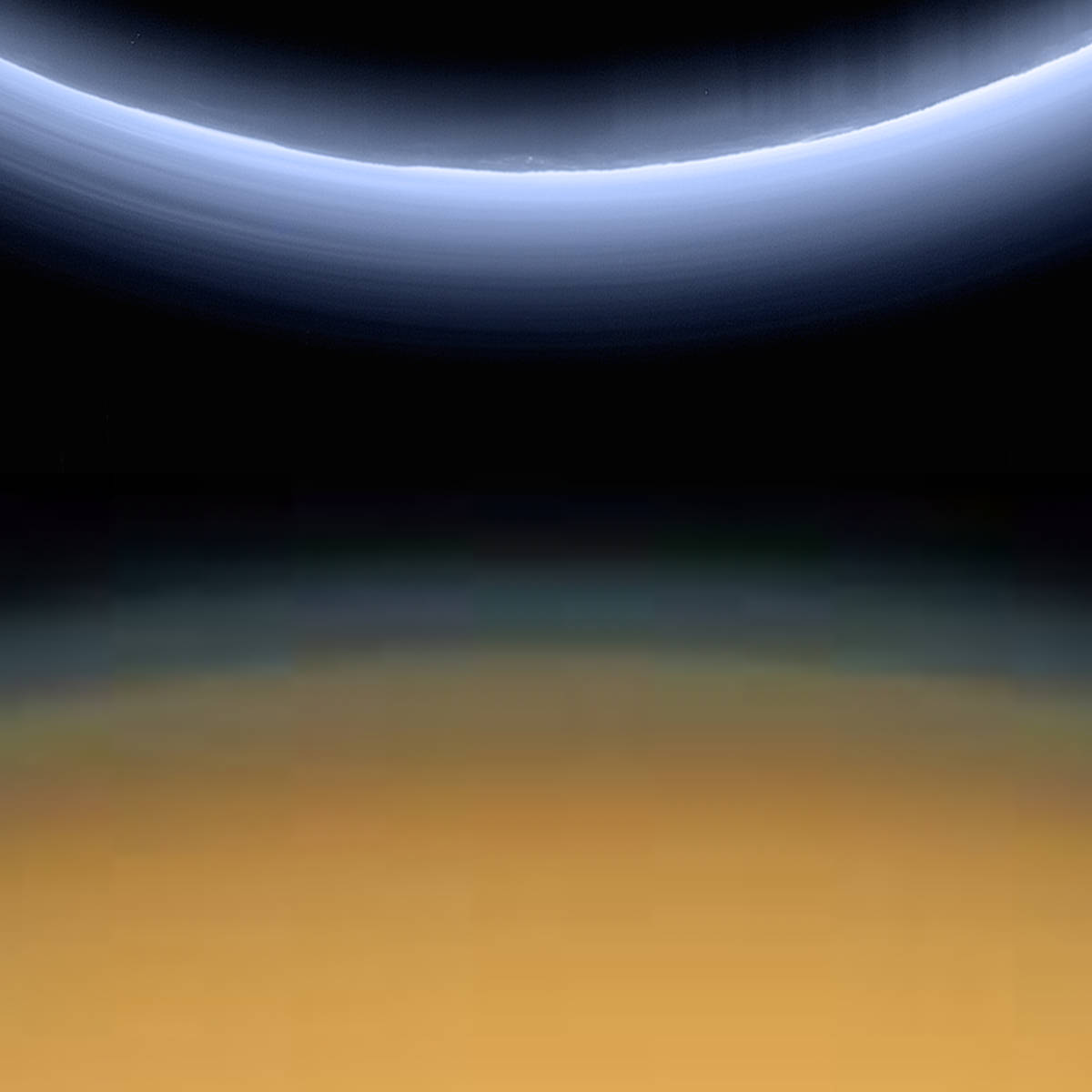
A composite view of a portion of the atmosphere of Titan and of a portion of the atmosphere of Pluto at scale
A composite view of a portion of the atmosphere of Titan 
    and of a portion of the atmosphere of Pluto at scale. Credit for the original view of Titan: 
    NASA/JPL-Caltech/Space Science Institute. Credit for the original view of Pluto: NASA/JHUAPL/SwRI. 
    Montage credit: Marc Lafferre, 2020.

This composite image reveals a portion of the atmosphere of Titan in the lower part of the view and a portion of the atmosphere of Pluto in the upper part of the view at scale. The original view of Titan whose file name is PIA14602.jpg was obtained on January 30, 2012 with the Wide-Angle Camera of the Cassini orbiter. The original view of Pluto was generated on the basis of data taken from the New Horizons probe on July 14, 2015. The atmosphere of Pluto is dominated by molecular nitrogen like the atmosphere of Titan and like the atmosphere of the Earth as well. Multiple layers can be clearly discerned in the atmosphere of Pluto like in the upper atmosphere of Titan.

Credit for the original view of Titan: NASA/JPL-Caltech/Space Science Institute.
Credit for the original view of Pluto: NASA/JHUAPL/SwRI.
Montage credit: Marc Lafferre, 2020.
(Natural intelligence)
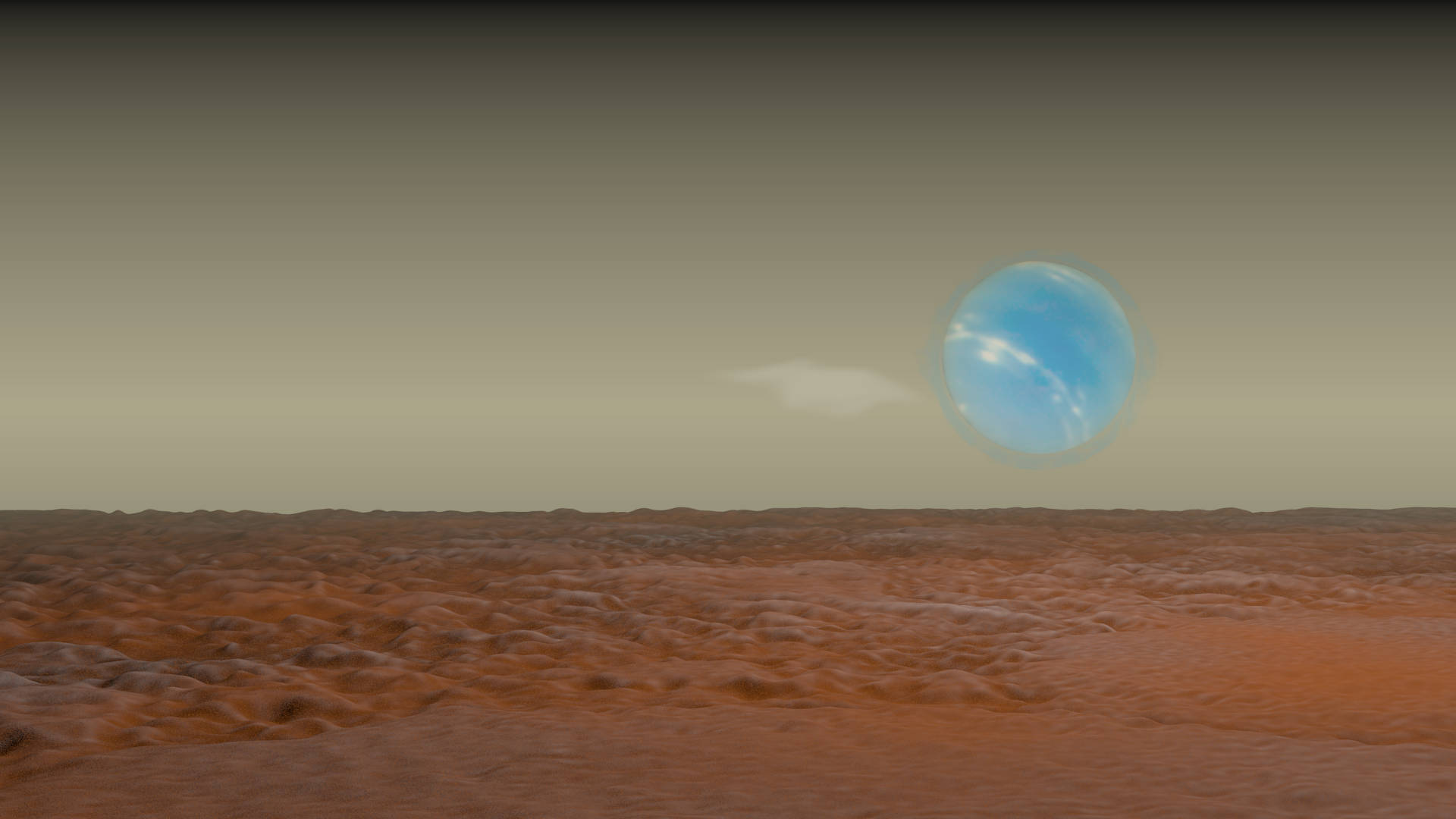
A simulated view of the landscape of Triton with the disc of Neptune on the horizon
A simulated view of the landscape of Triton with 
    the disc of Neptune visible on the horizon. Credit for the original view of Neptune: 
    ESO/VLT/MUSE/GALACSI/P. Weilbacher (AIP). Montage credit: Marc Lafferre, 2020.

This image represents a simulated view of the landscape of Triton with the disc of the gas giant Neptune visible on the horizon. The lateral field of view represents about 60.28 degrees and the apparent diameter of the disc of Neptune is about 8 degrees. Therefore, the apparent diameter of Neptune from the surface of Triton would represent about 15 times the apparent diameter of the Moon from the surface of the Earth. The semi-major axis of Triton is equal to 354 759 kilometers (about 220 437 miles). The images of Triton acquired from the Voyager 2 spacecraft have clearly revealed an active surface with cryovolcanoes or geysers in an extremely harsh environment.

Credit for the original view of Neptune: ESO/VLT/MUSE/GALACSI/P. Weilbacher (AIP).
Montage credit: Marc Lafferre, 2020.
(Natural intelligence)
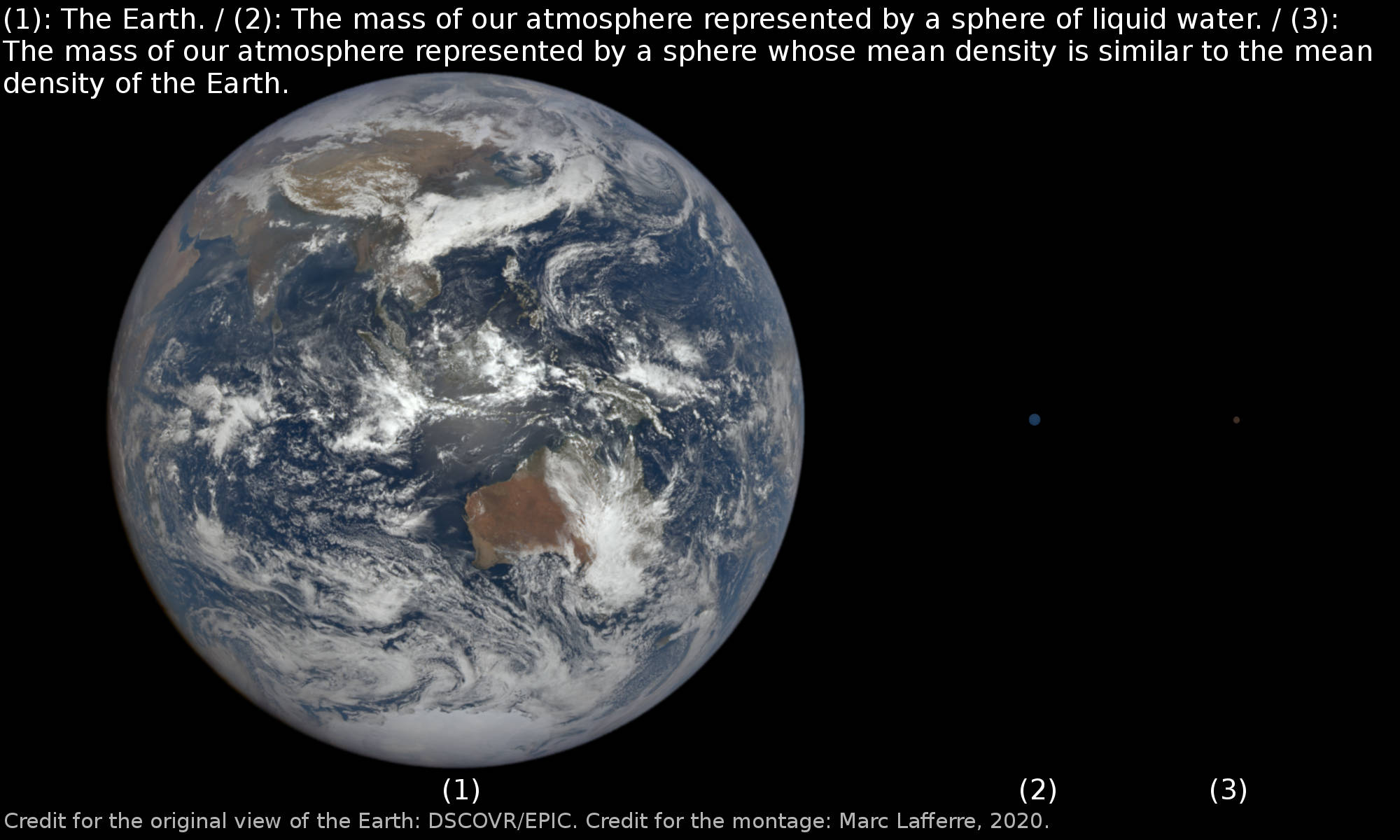
A composite view of the Earth, of the sphere of liquid water representing the mass of its atmosphere and of the sphere representing the mass of its atmosphere with a mean density similar to the mean density of the Earth at scale
A composite view of the Earth, of the sphere of 
    liquid water representing the mass of its atmosphere and of the sphere representing the mass of its 
    atmosphere with a mean density similar to the mean density of the Earth at scale with notes. Credit for 
    the original view of the Earth: NASA/DSCOVR/EPIC. Montage credit: Marc Lafferre, 2020.
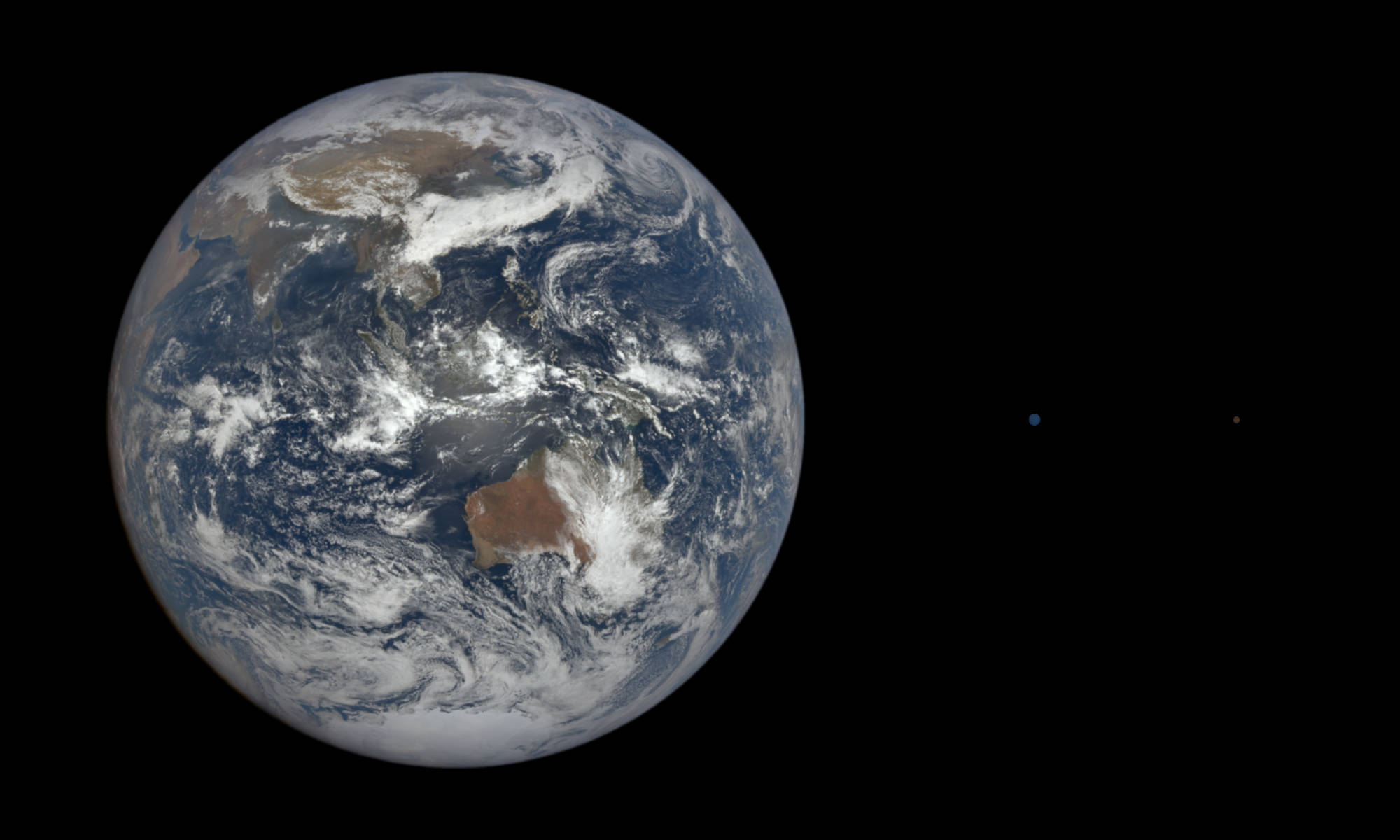
A composite view of the Earth, of the sphere of 
    liquid water representing the mass of its atmosphere and of the sphere representing the mass of its 
    atmosphere with a mean density similar to the mean density of the Earth at scale without notes. Credit 
    for the original view of the Earth: NASA/DSCOVR/EPIC. Montage credit: Marc Lafferre, 2020.

This composite view reveals, from left to right, the Earth, a sphere of liquid water representing the mass of its atmosphere as well as a sphere whose mean density is equal to the mean density of the Earth and whose mass represents the mass of the atmosphere of the Earth. The diameter of the sphere of water representing the mass of the atmosphere of the Earth would represent about 214.23 kilometers (around 133.12 miles). The diameter of the sphere whose mean density is equal to the mean density of the Earth and whose mass represents the mass of the atmosphere of the Earth would represent about 121.25 kilometers (around 75.34 miles). The original view of the Earth was obtained on March 4, 2020 with the EPIC instrument of the DSCOVR spacecraft.

Credit for the original view of the Earth: NASA/DSCOVR/EPIC.
Montage credit: Marc Lafferre, 2020.
(Natural intelligence)
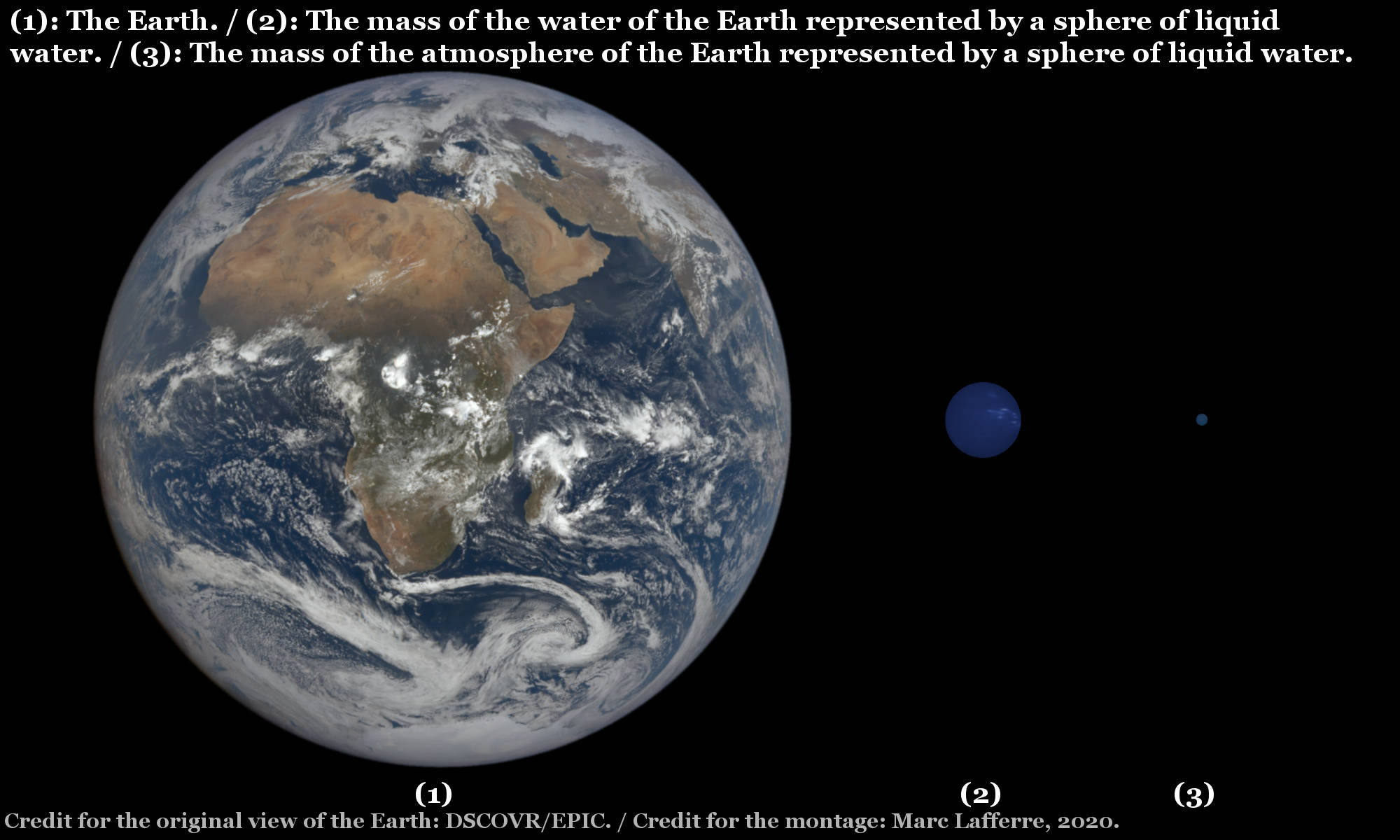
A composite view of the Earth, of a sphere of liquid water representing the mass of the hydrosphere of the Earth and of a sphere of water representing the mass of the atmosphere of the Earth at scale
A composite view of the Earth, of a sphere of liquid 
    water representing the mass of the hydrosphere of the Earth and of a sphere of water representing the mass 
    of the atmosphere of the Earth at scale with notes. Credit for the original view of the Earth: 
    NASA/DSCOVR/EPIC. Montage credit: Marc Lafferre, 2020.
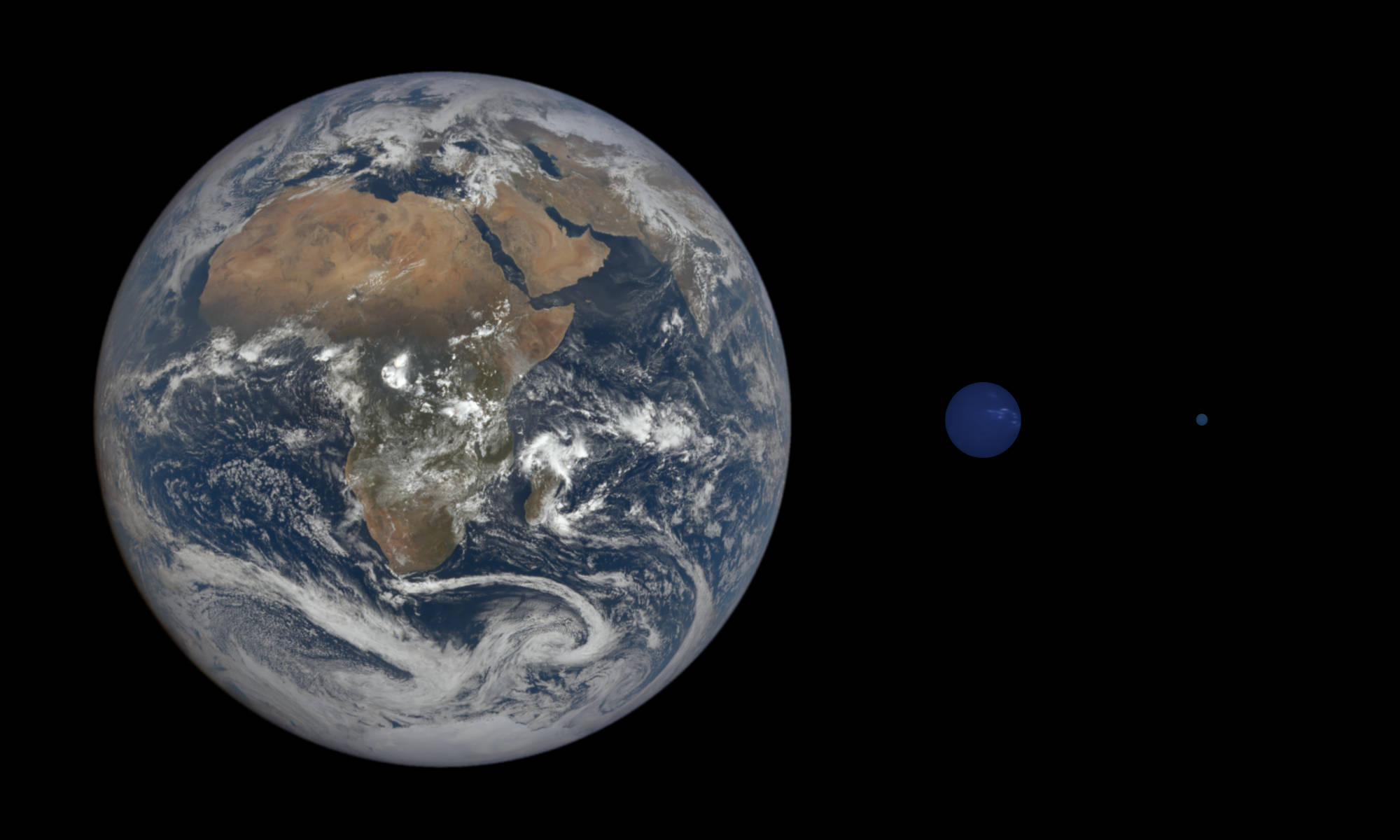
A composite view of the Earth, of a sphere of liquid 
    water representing the mass of the hydrosphere of the Earth and of a sphere of water representing the mass 
    of the atmosphere of the Earth at scale without notes. Credit for the original view of the Earth: 
    NASA/DSCOVR/EPIC. Montage credit: Marc Lafferre, 2020.

This composite view reveals, from left to right, the Earth, a sphere of liquid water representing the mass of the hydrosphere of the Earth and a sphere of liquid water representing the mass of the atmosphere of the Earth at scale. The diameter of the sphere of liquid water representing the mass of the hydrosphere of the Earth represents about 1383.32 kilometers (around 860 miles). The diameter of the sphere of liquid water representing the mass of the atmosphere of the Earth is equal to about 214.23 kilometers (around 133.12 miles). The original view of the Earth was obtained on March 6, 2020 with the EPIC instrument of the DSCOVR spacecraft.

Credit for the original view of the Earth: NASA/DSCOVR/EPIC.
Montage credit: Marc Lafferre, 2020.
(Natural intelligence)
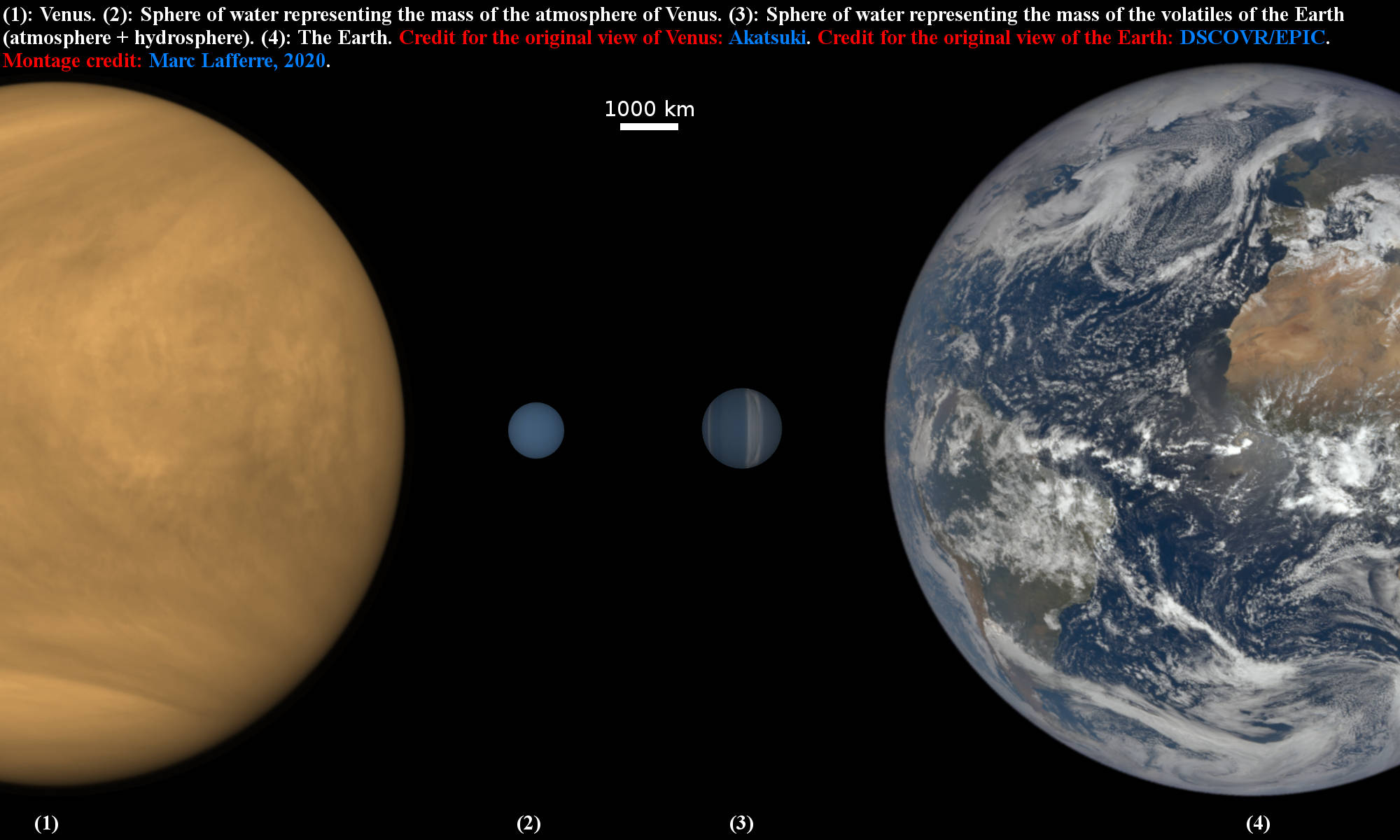
A composite view of Venus, of a sphere of liquid water representing the mass of the atmosphere of Venus, of a sphere of liquid water representing the mass of the volatiles of the Earth (Atmosphere and hydrosphere) and of the Earth at scale
A composite view of Venus, of a sphere of liquid 
    water representing the mass of the atmosphere of Venus, of a sphere of liquid water representing the mass 
    of the volatiles of the Earth (Atmosphere and hydrosphere) and of the Earth at scale with notes. Credit 
    for the original view of Venus: Akatsuki/ISAS/JAXA. Credit for the original view of the Earth: 
    NASA/DSCOVR/EPIC. Montage credit: Marc Lafferre, 2020.
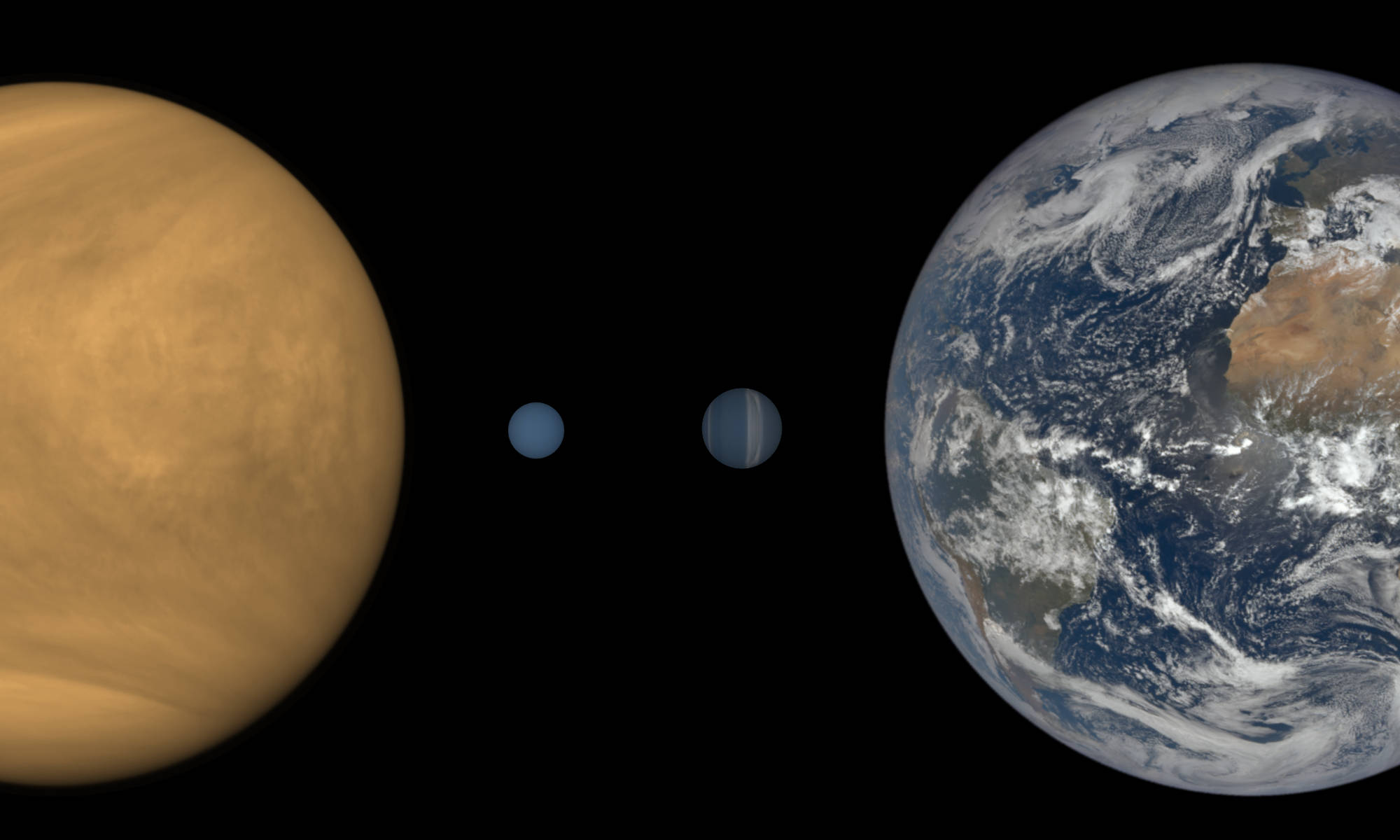
A composite view of Venus, of a sphere of liquid 
    water representing the mass of the atmosphere of Venus, of a sphere of liquid water representing the mass 
    of the volatiles of the Earth (Atmosphere and hydrosphere) and of the Earth at scale without notes. Credit 
    for the original view of Venus: Akatsuki/ISAS/JAXA. Credit for the original view of the Earth: 
    NASA/DSCOVR/EPIC. Montage credit: Marc Lafferre, 2020.

This composite view reveals, from left to right, a portion of Venus, a sphere of liquid water representing the mass of the atmosphere of Venus, a sphere of liquid water representing the mass of the volatiles (Hydrosphere and atmosphere) of the Earth and a portion of the Earth at scale. The original view of Venus was acquired from the Akatsuki spacecraft during its mission around Venus. The original view of the Earth was obtained on March 25, 2020 with the EPIC instrument of the DSCOVR spacecraft. The diameter of the sphere of liquid water representing the mass of the atmosphere of Venus is equal to about 969.65 kilometers (around 602.51 miles). The diameter of the sphere of liquid water representing the mass of the volatiles of the Earth is equal to about 1385.03 kilometers (around 860.62 miles). Therefore, one can notice that the Earth is richer in volatiles than Venus thanks to its huge hydrosphere or thanks to its oceans.

Credit for the original view of Venus: Akatsuki/ISAS/JAXA.
Credit for the original view of the Earth: NASA/DSCOVR/EPIC.
Montage credit: Marc Lafferre, 2020.
(Natural intelligence)
Back to main page