Infographics 2021

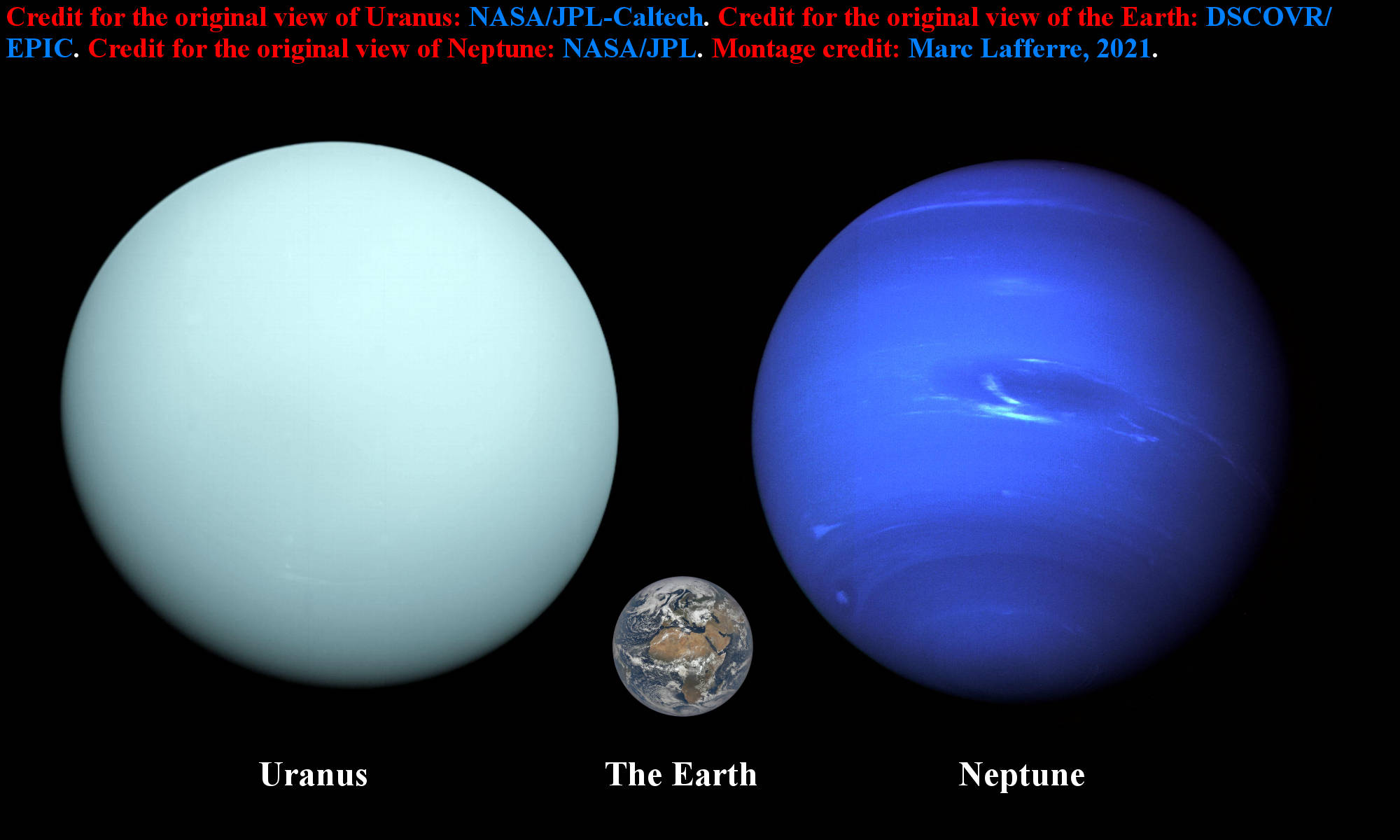
A composite view of Uranus, the Earth and Neptune at scale
A composite view of Uranus, the Earth and Neptune at scale 
    with notes. Credit for the original view of Uranus: NASA/JPL-Caltech. Credit for the original view of the Earth: 
    NASA/DSCOVR/EPIC. Credit for the original view of Neptune: NASA/JPL. Montage credit: Marc Lafferre, 2021.
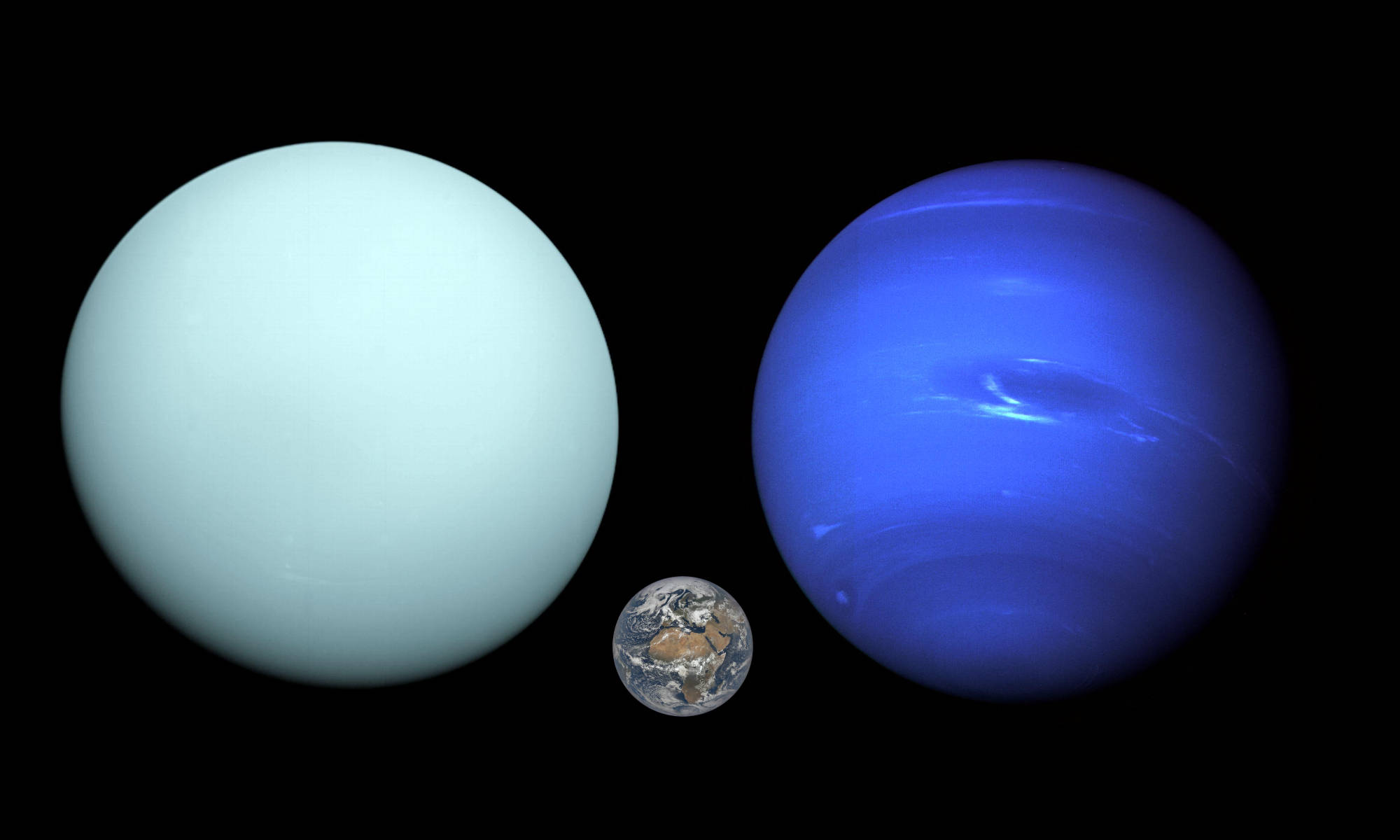
A composite view of Uranus, the Earth and Neptune at scale 
    without notes. Credit for the original view of Uranus: NASA/JPL-Caltech. Credit for the original view of the Earth: 
    NASA/DSCOVR/EPIC. Credit for the original view of Neptune: NASA/JPL. Montage credit: Marc Lafferre, 2021.

This composite view reveals, from left to right, Uranus, the Earth and Neptune at scale. The original view of Uranus was acquired from the Voyager 2 spacecraft during its historic flyby of the Gas Giant performed in 1986. The original view of the Earth was taken with the EPIC instrument of the DSCOVR spacecraft on June 2, 2021. The original view of Neptune was captured from the Voyager 2 spacecraft during its historic flyby of the Gas Giant performed in 1989.

Credit for the original view of Uranus: NASA/JPL-Caltech.
Credit for the original view of the Earth: NASA/DSCOVR/EPIC.
Credit for the original view of Neptune: NASA/JPL.
Montage credit: Marc Lafferre, 2021.
(Natural intelligence)
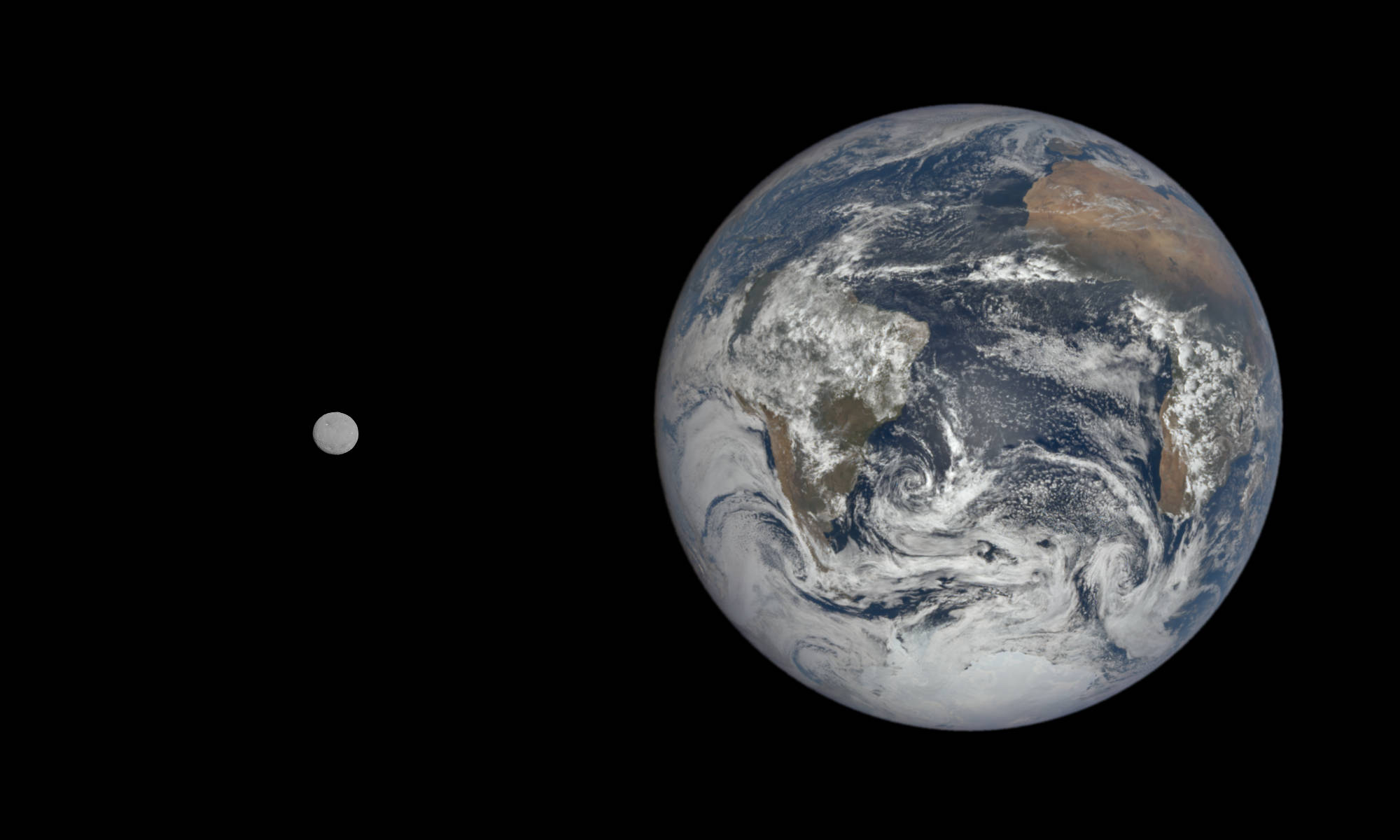
A composite view of Ceres and the Earth at scale
A composite view of Ceres and the Earth at scale. Credit for 
    the original view of Ceres: NASA/JPL-Caltech/UCLA/MPS/DLR/IDA. Credit for the original view of the Earth: 
    NASA/DSCOVR/EPIC. Montage credit: Marc Lafferre, 2021.

This composite image reveals the dwarf planet Ceres and the Earth at scale. Ceres represents the largest body of the asteroid belt. Ceres is relatively tiny compared to the Moon or the Earth but the world is big enough to appear roughly spherical. The mean diameter of Ceres is around 952.4 kilometers (around 592 miles). The size of the disc of Ceres is comparable to the size of a country like France for instance. Ceres evolves between Mars and Jupiter. The view of the Earth in the composite image was taken from the DSCOVR spacecraft on December 11, 2021.

Credit for the original view of Ceres: NASA/JPL-Caltech/UCLA/MPS/DLR/IDA.
Credit for the original view of the Earth: NASA/DSCOVR/EPIC.
Montage credit: Marc Lafferre, 2021.
(Natural intelligence)
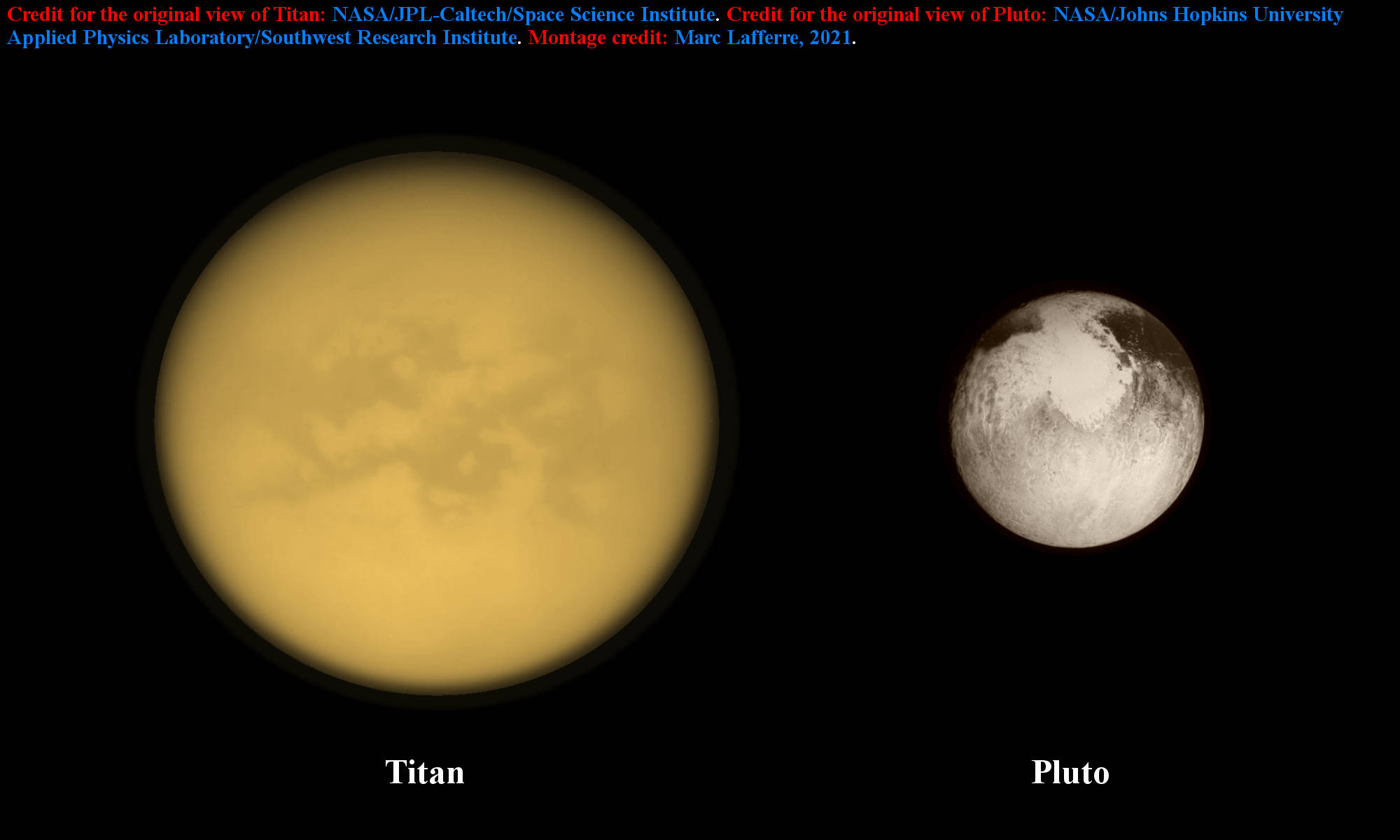
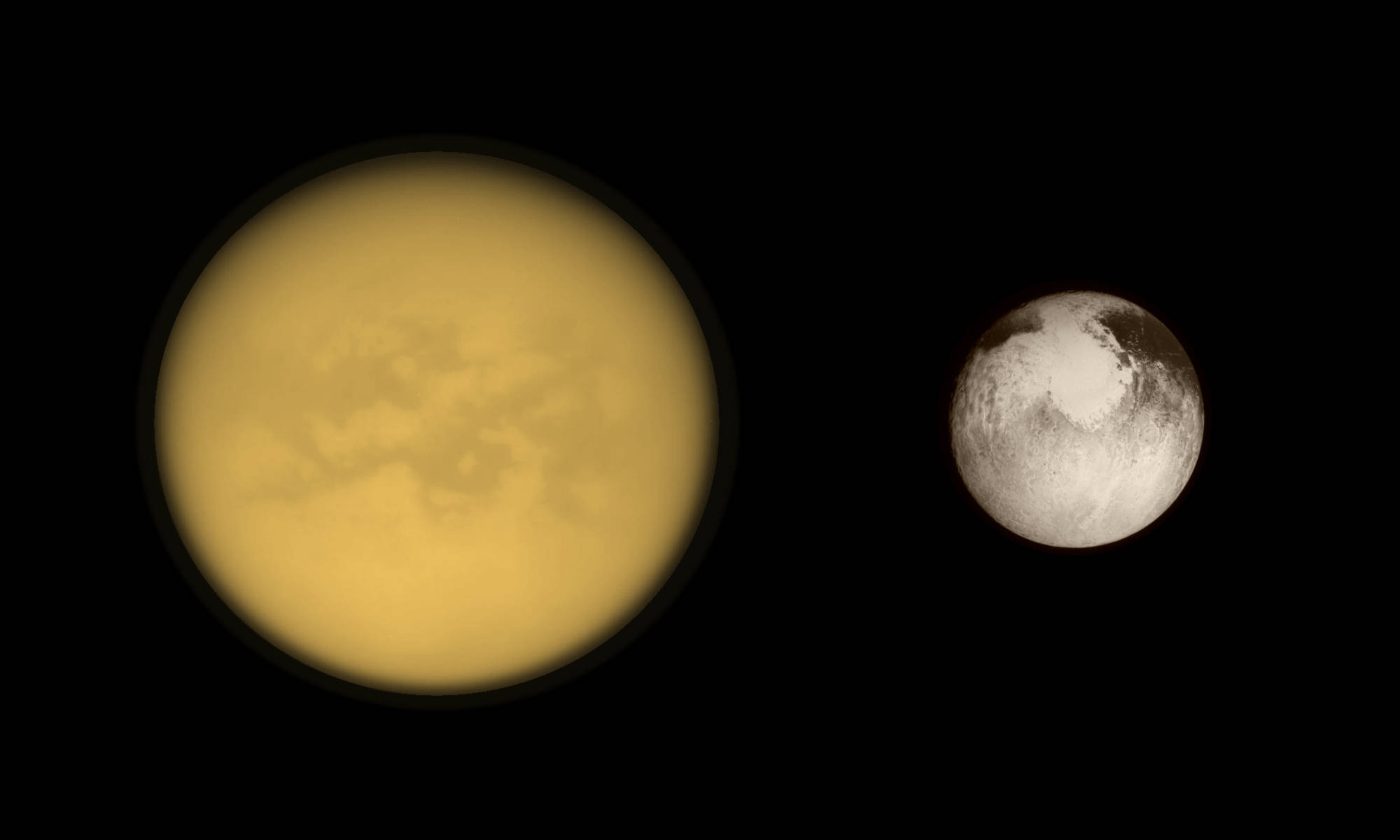
A composite view of Titan and Pluto at scale
A composite view of Titan and Pluto at scale with notes. 
    Credit for the original view of Titan: NASA/JPL-Caltech/Space Science Institute. Credit for the original view of 
    Pluto: NASA/Johns Hopkins University Applied Physics Laboratory/Southwest Research Institute. Montage credit: Marc 
    Lafferre, 2021.
A composite view of Titan and Pluto at scale without notes. 
    Credit for the original view of Titan: NASA/JPL-Caltech/Space Science Institute. Credit for the original view of 
    Pluto: NASA/Johns Hopkins University Applied Physics Laboratory/Southwest Research Institute. Montage credit: Marc 
    Lafferre, 2021.

A mosaic representing Titan and Pluto at scale. The original view of Titan was obtained from the Cassini spacecraft during its mission in the Saturn system. The original image of Pluto was taken from the New Horizons spacecraft during its historic flyby of 2015. The surface of Titan can't be discerned from outer space in the visible spectrum. The infrared or near-infrared eyes of the Cassini orbiter can reveal surface details of the giant moon of Saturn.

Credit for the original view of Titan: NASA/JPL-Caltech/Space Science Institute.
Credit for the original view of Pluto: NASA/Johns Hopkins University Applied Physics Laboratory/Southwest Research Institute.
Montage credit: Marc Lafferre, 2021.
(Natural intelligence)
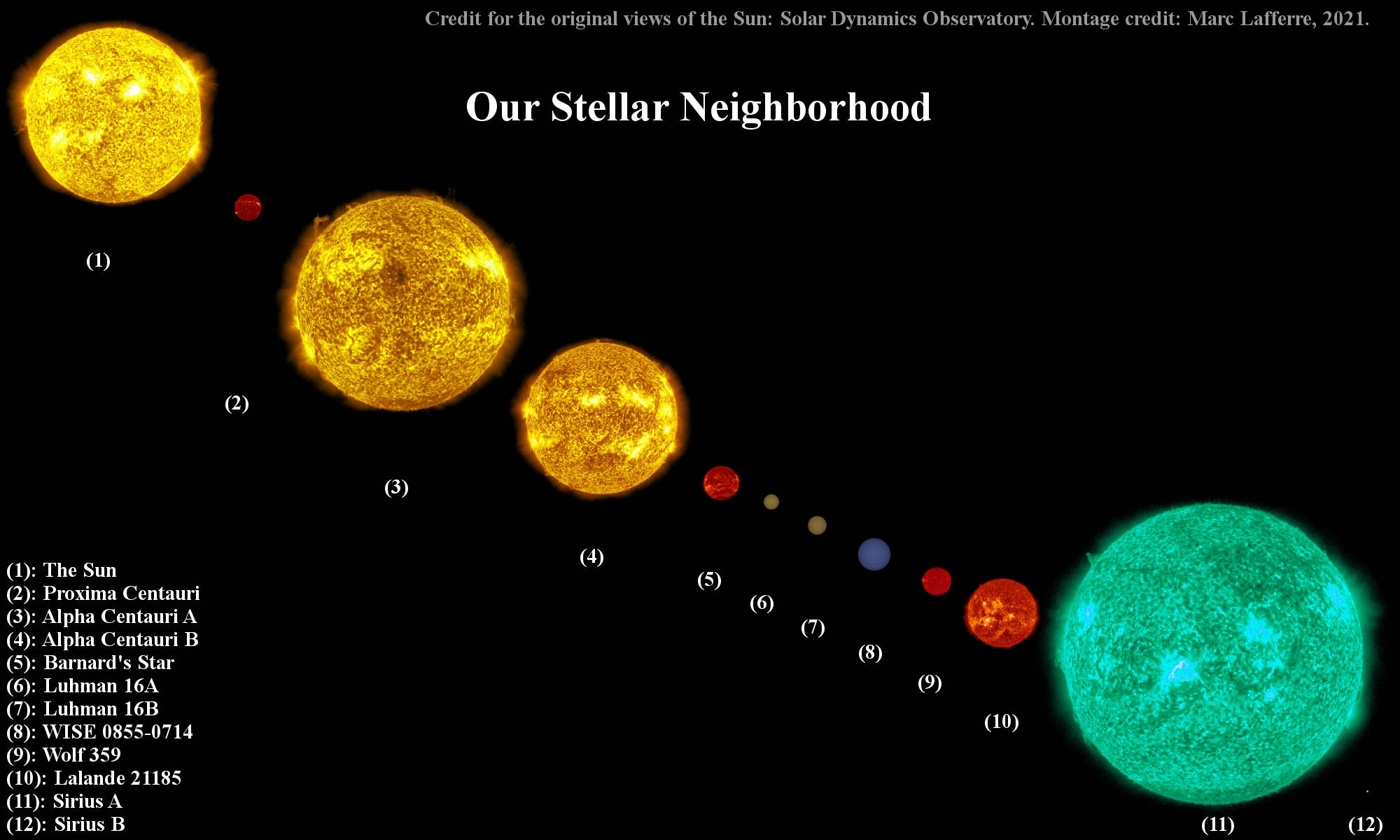
Our stellar neighborhood from the Sun to Sirius B
A composite view of the nearest stars to the Earth at scale in 
    terms of size. Credit for the original view of the stars except Luhman 16A, Luhman 16B, WISE 0855-0714 and Sirius B: 
    NASA/SDO. Montage credit: Marc Lafferre, 2021.

A composite view of the nearest stars to the Earth at scale. The appearance of Proxima Centauri, Alpha Centauri A, Alpha Centauri B, Barnard's S, Wolf 359, Lalande 21185 and Sirius A does not represent their real appearance and is based on data regarding the appearance of the Sun acquired from the Solar Dynamics Observatory. Luhman 16A and Luhman 16B represent brown dwarfs that is to say substellar objects that can emit light. The mass of brown dwarfs can represent the equivalent of 13 Jupiter masses up to 80 Jupiter masses. Brown dwarfs are not massive enough to sustain the nuclear fusion of hydrogen into helium in their core. Sirius B is relatively tiny but extremely massive. Sirius B is in fact a white dwarf, that is to say a stellar core that had emerged from the end of the process of nuclear fusion in the core of an ancient star whose mass was at a low or medium level. The order of distance from us increases from the left to the right in the infographics.

Credit for the original view of the stars except Luhman 16A, Luhman 16B, WISE 0855-0714 and Sirius B: NASA/SDO.
Montage credit: Marc Lafferre, 2021.
(Natural intelligence)
A simulated view of Punga Mare on Titan with the disc of Saturn visible on the horizon
A simulated view of Punga Mare on Saturn's largest moon 
    Titan with the disc of Saturn visible on the horizon. Montage credit: Marc Lafferre, 2021.

This image represents a simulated view of Punga Mare, one of the major pools of hydrocarbons found in the high latitudes of the giant moon Titan. The disc of the gas giant Saturn can be discerned on the horizon. The apparent diameter of the disc of Saturn from the surface of Titan represents around 5.65 degrees. If one could discern the disc of Saturn from the surface of Titan through the opaque atmosphere in the visible spectrum, the apparent diameter of the disc of the gas giant would represent the equivalent of about 11 times the apparent diameter of the Moon observed from the surface of the Earth. The pools of Titan can be composed of a mixture of methane and ethane in particular. The lateral field of view of the simulated snapshot is around 60.28 degrees. The relative size of the disc of Saturn is respected in this image.

Montage credit: Marc Lafferre, 2021.
(Natural intelligence)

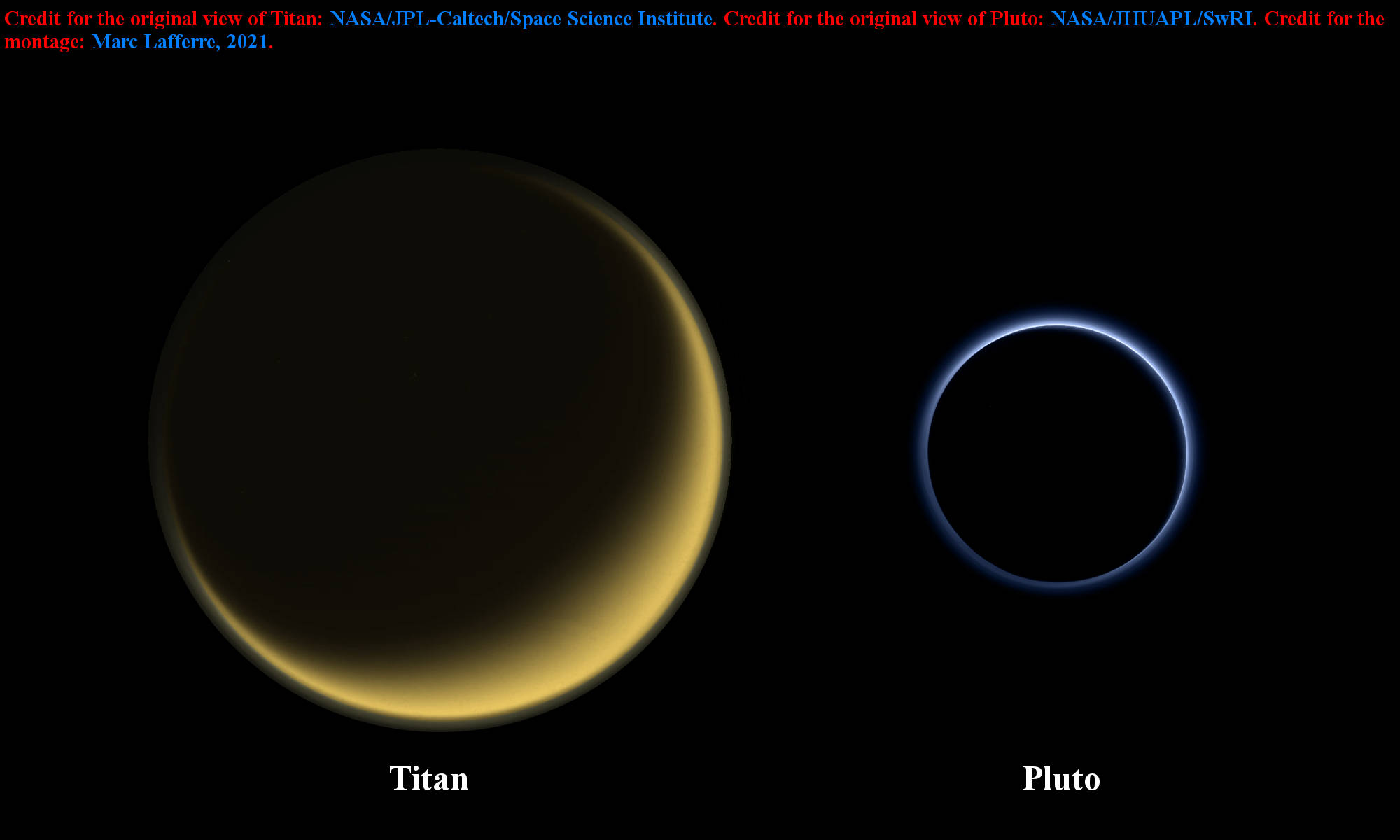
A Composite view of Titan and Pluto at scale with the Sun located on the other side of Titan and Pluto
A composite view of Titan and Pluto at scale with the Sun 
    located on the other side of Titan and Pluto with notes. Credit for the original view of Titan: 
    NASA/JPL-Caltech/Space Science Institute. Credit for the original view of Pluto: NASA/JHUAPL/SwRI. 
    Montage credit: Marc Lafferre, 2021.
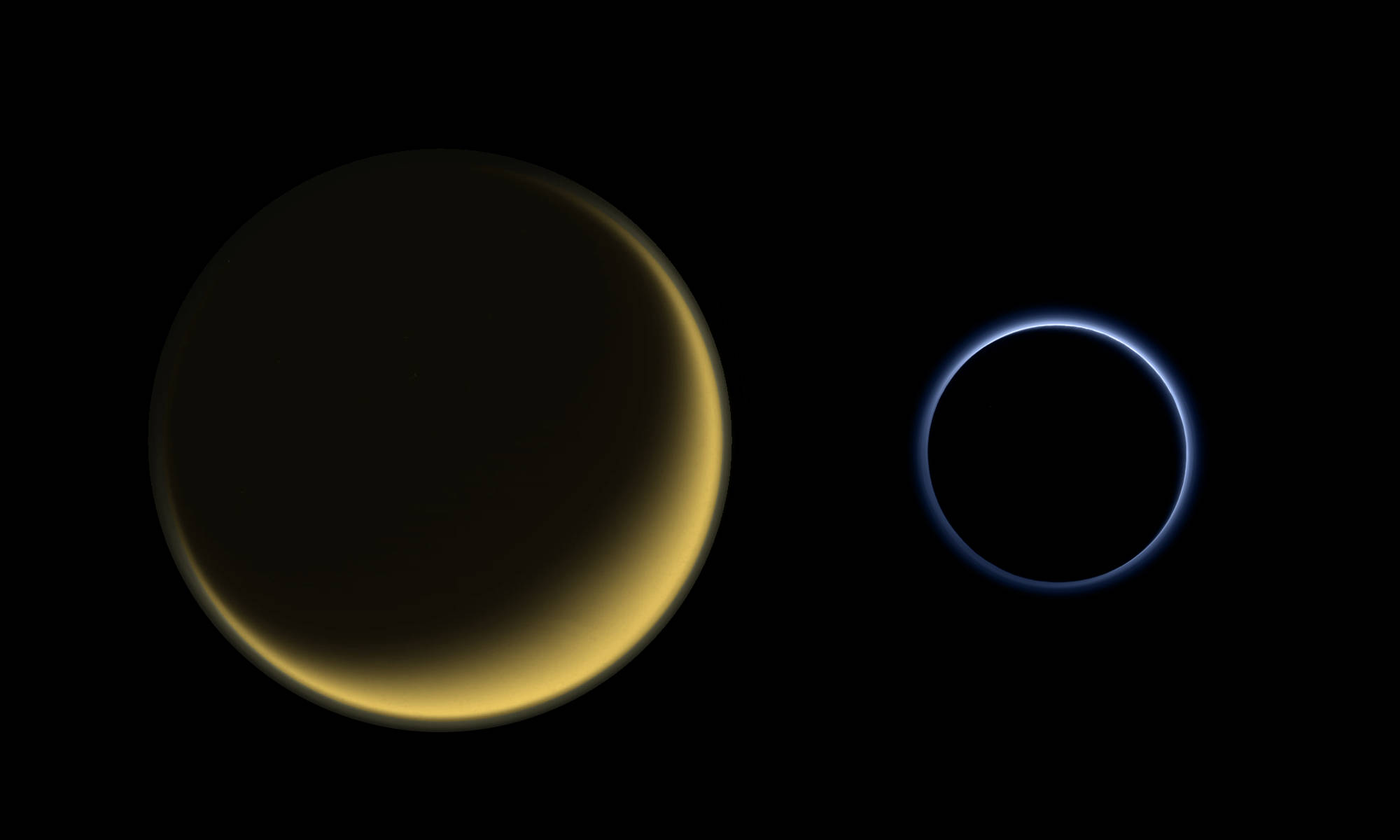
A composite view of Titan and Pluto at scale with the Sun 
    located on the other side of Titan and Pluto without notes. Credit for the original view of Titan: 
    NASA/JPL-Caltech/Space Science Institute. Credit for the original view of Pluto: NASA/JHUAPL/SwRI. 
    Montage credit: Marc Lafferre, 2021.

This composite view reveals Titan and Pluto at scale in a configuration in which the Sun is located on the other side of the planetary body. That configuration allows us to clearly identify the upper atmosphere of Titan as well as the multiple layers of the atmosphere of Pluto. The atmosphere of Saturn's largest moon Titan and the atmosphere of the dwarf planet Pluto are dominated by molecular nitrogen like the atmosphere of the Earth. The structure of the atmosphere of Pluto is reminiscent of the structure of the upper atmosphere of Titan.

Credit for the original view of Titan: NASA/JPL-Caltech/Space Science Institute.
Credit for the original view of Pluto: NASA/JHUAPL/SwRI.
Montage credit: Marc Lafferre, 2021.
(Natural intelligence)
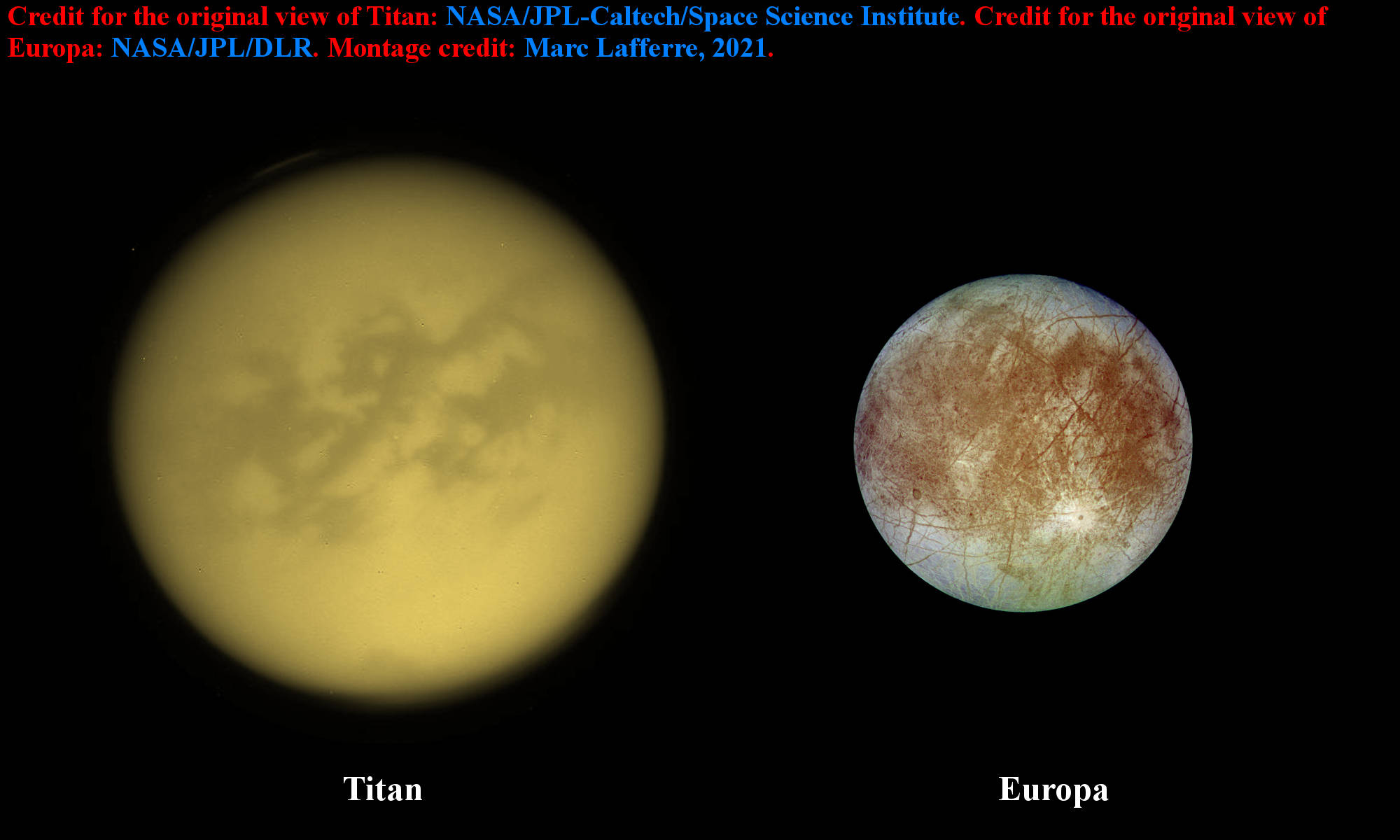
A composite view of Titan and Europa at scale
A composite view of Titan and Europa at scale with 
    notes. Credit for the original view of Titan: NASA/JPL-Caltech/Space Science Institute. Credit for the original 
    view of Europa: NASA/JPL/DLR. Montage credit: Marc Lafferre, 2021.
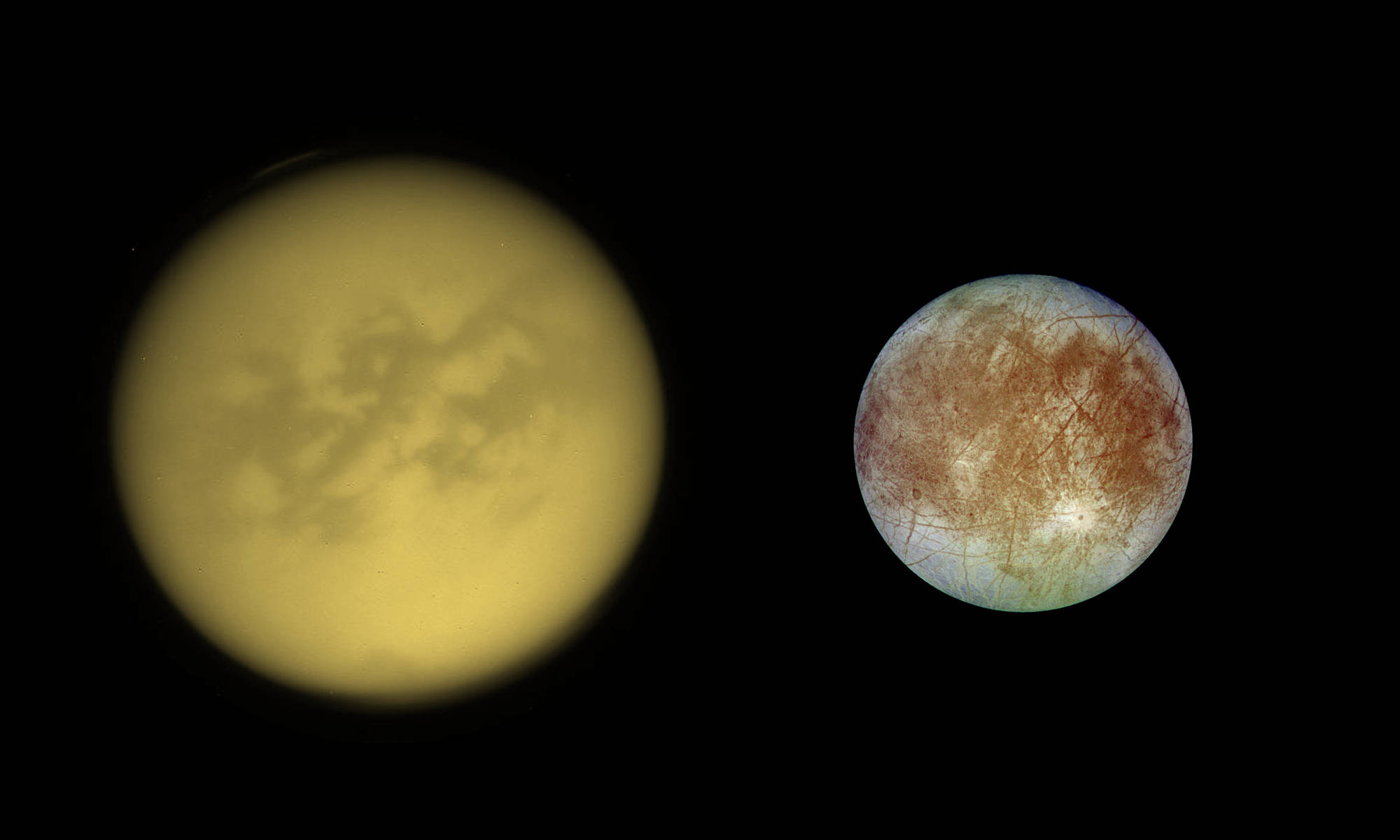
A composite view of Titan and Europa at scale without 
    notes. Credit for the original view of Titan: NASA/JPL-Caltech/Space Science Institute. Credit for the original 
    view of Europa: NASA/JPL/DLR. Montage credit: Marc Lafferre, 2021.

This composite view reveals Titan and Europa at scale. Titan contains a relatively significant atmosphere that appears completely opaque from outer space in the visible spectrum. Europa is devoid of any significant atmosphere and clearly reveals a fractured surface. The file name of the original view of Saturn's largest moon Titan is N00191987.jpg. The giant moon of the Ringed Planet was observed from the Cassini orbiter with the CL1 filter and with the CB3 filter on June 29, 2012. The colors of Titan in this composite view are artificial. The original image of Europa was taken on September 7, 1996 from the Galileo orbiter.

Credit for the original view of Titan: NASA/JPL-Caltech/Space Science Institute.
Credit for the original view of Europa: NASA/JPL/DLR.
Montage credit: Marc Lafferre, 2021.
(Natural intelligence)
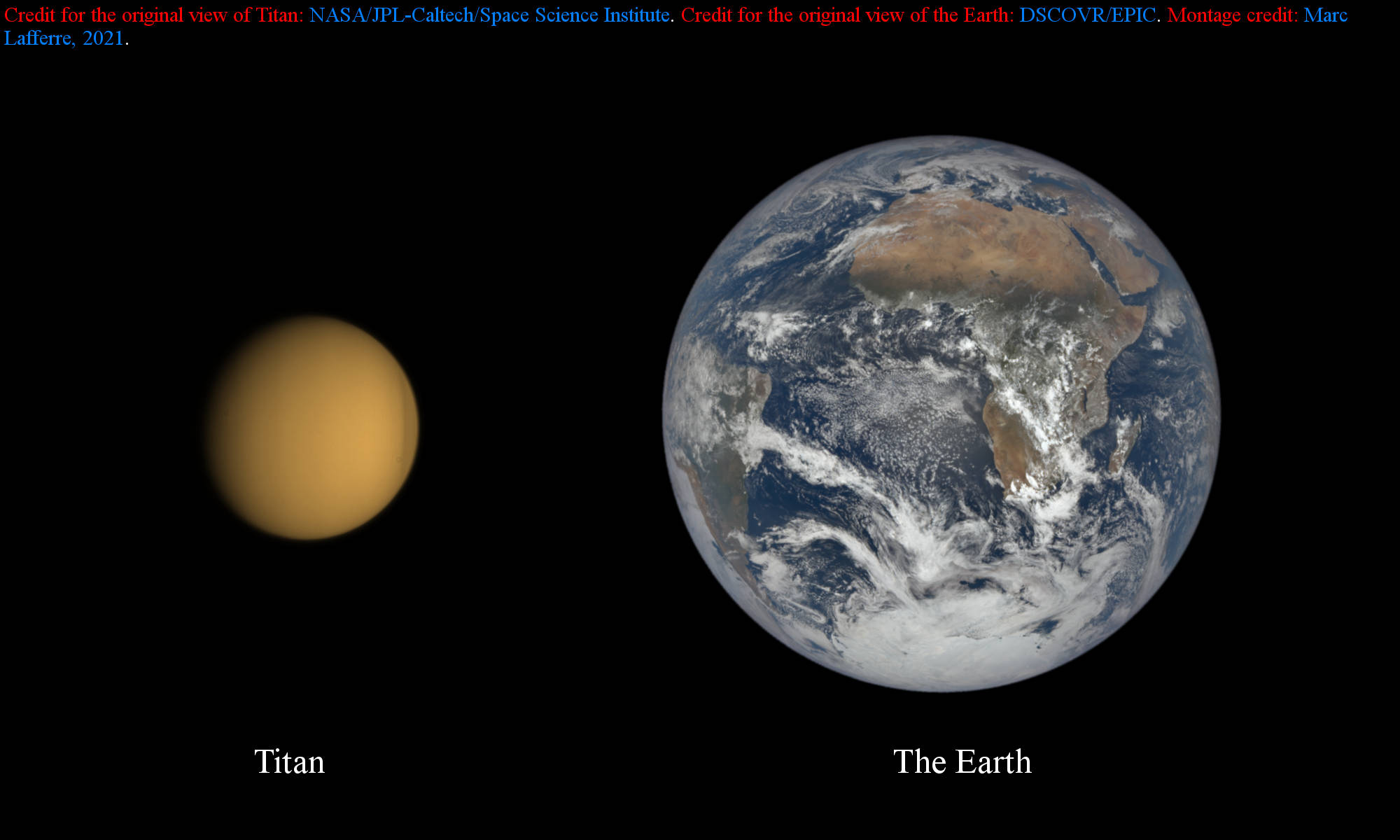
A composite view of Titan and the Earth at scale
A composite view of Titan and the Earth at scale with 
    notes. Credit for the original view of Titan: NASA/JPL-Caltech/Space Science Institute. Credit for the original 
    view of the Earth: NASA/DSCOVR/EPIC. Montage credit: Marc Lafferre, 2021.
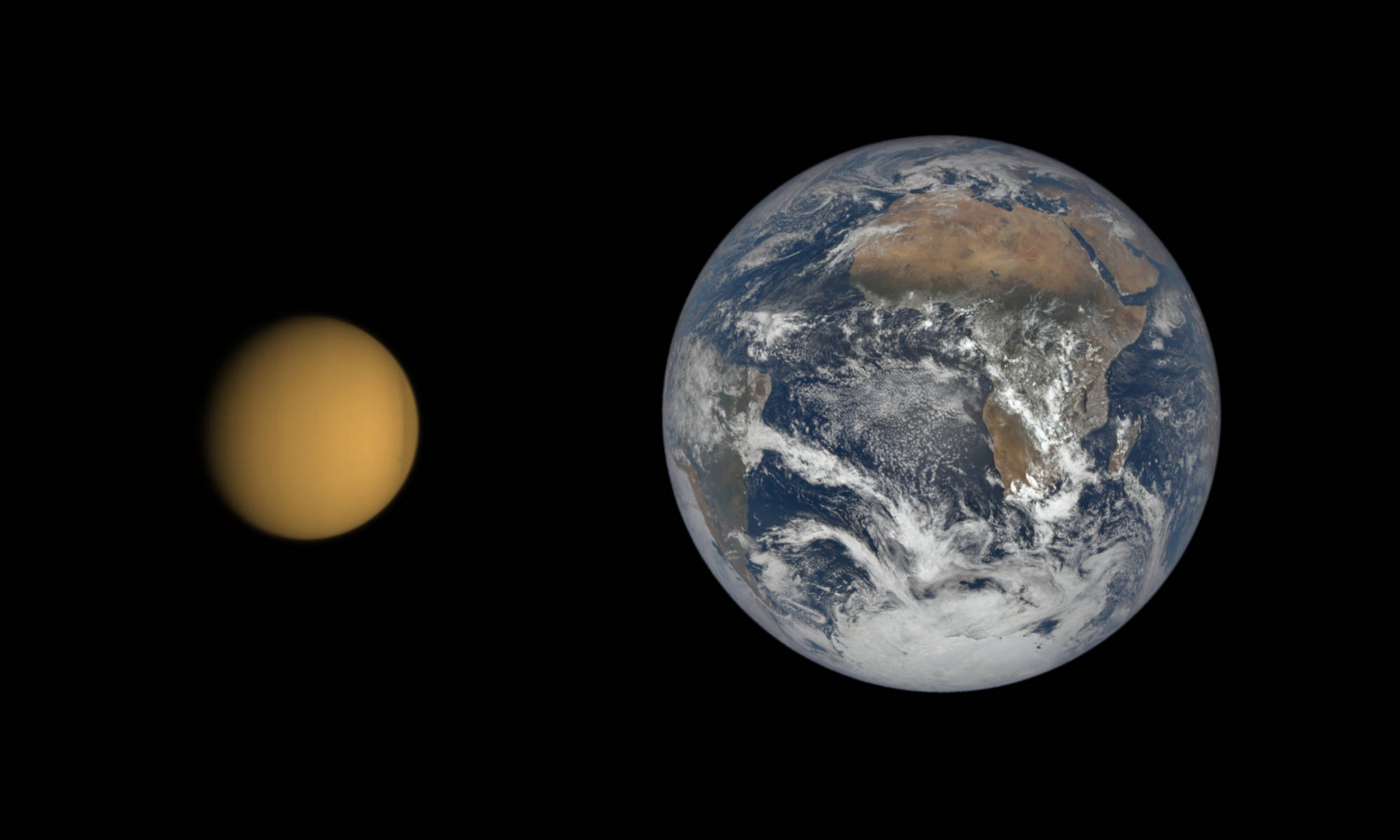
A composite view of Titan and the Earth at scale without 
    notes. Credit for the original view of Titan: NASA/JPL-Caltech/Space Science Institute. Credit for the original 
    view of the Earth: NASA/DSCOVR/EPIC. Montage credit: Marc Lafferre, 2021.

This composite image reveals Titan and the Earth at scale. Titan is the largest moon of Saturn and the second largest moon in the Solar System. The original image of Titan was obtained from the Cassini orbiter on December 30, 2015. The image of the giant moon was taken with the BL1 filter and with the CL2 filter. The file name of the original view is N00253709.jpg. The original view of the Blue Planet was taken on November 22, 2021 with the EPIC instrument of the DSCOVR spacecraft. The colors of Titan are artificial in this composite image. The global haze of Saturn's largest moon prevents us from discerning surface features from outer space in the visible spectrum.

Credit for the original view of Titan: NASA/JPL-Caltech/Space Science Institute.
Credit for the original view of the Earth: NASA/DSCOVR/EPIC.
Montage credit: Marc Lafferre, 2021.
(Natural intelligence)
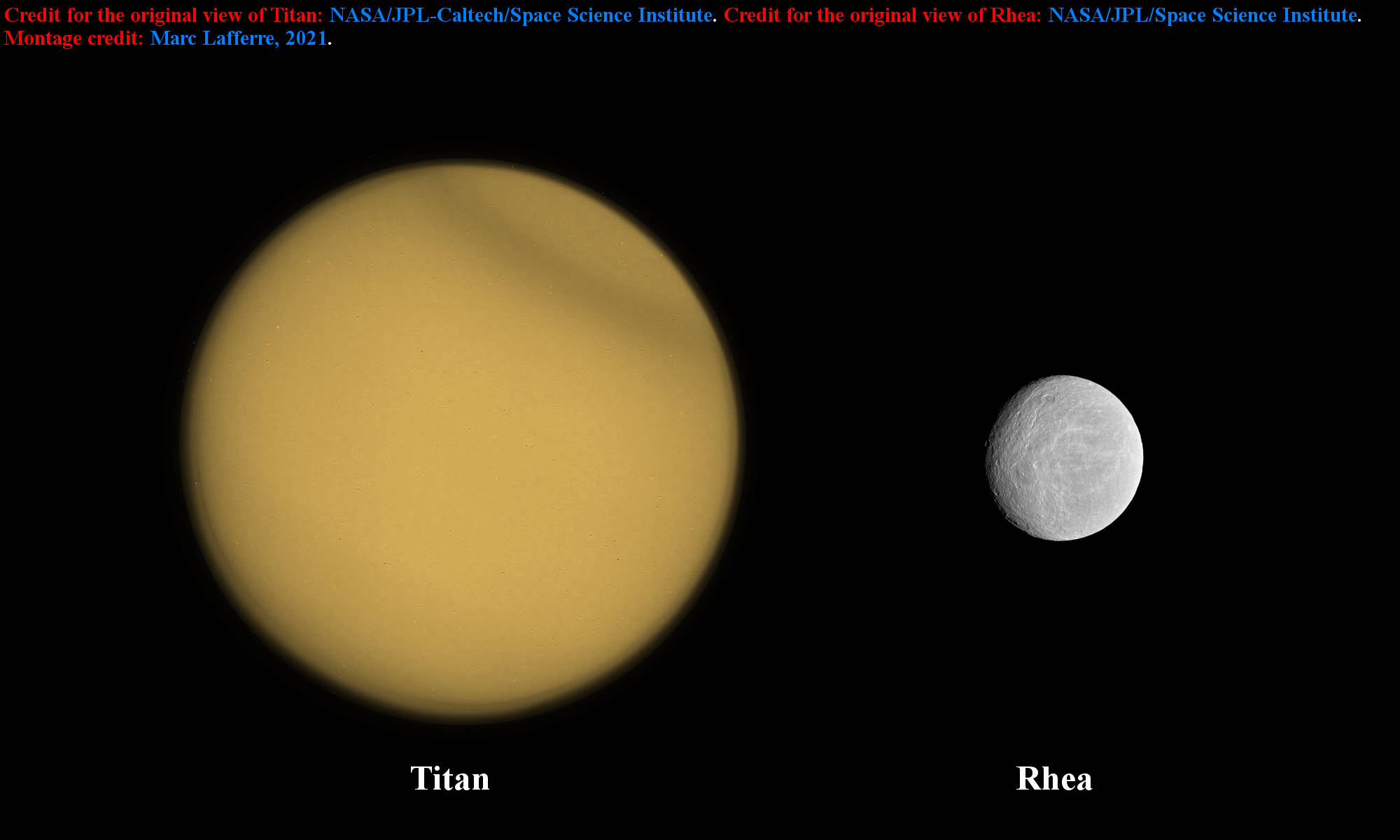
A composite view of Titan and Rhea at scale
A composite view of Titan and Rhea at scale with notes. 
    Credit for the original view of Titan: NASA/JPL-Caltech/Space Science Institute. Credit for the original 
    view of Rhea: NASA/JPL/Space Science Institute. Montage credit: Marc Lafferre, 2021.
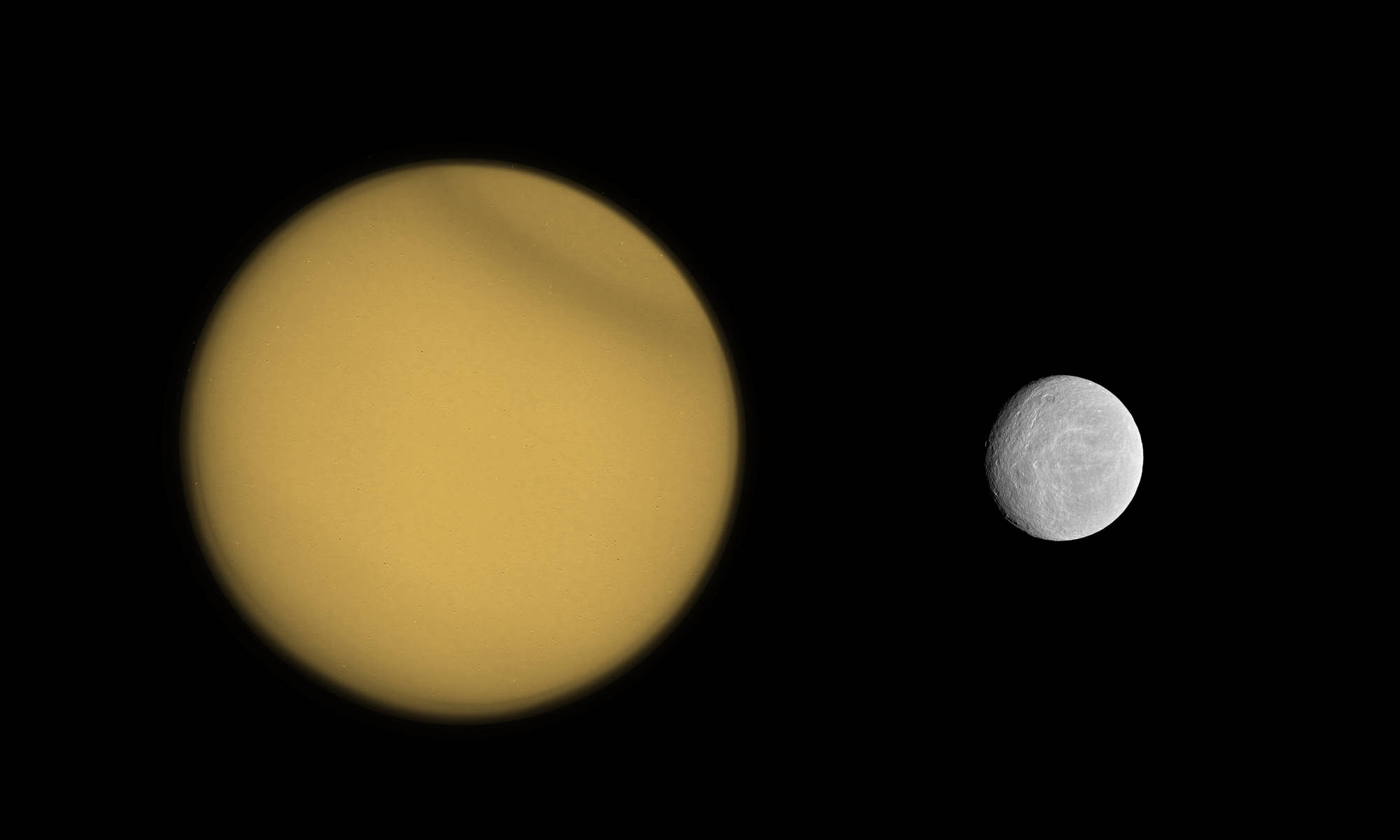
A composite view of Titan and Rhea at scale without notes. 
    Credit for the original view of Titan: NASA/JPL-Caltech/Space Science Institute. Credit for the original 
    view of Rhea: NASA/JPL/Space Science Institute. Montage credit: Marc Lafferre, 2021.

This composite view reveals Titan and Rhea at scale. Titan represents the largest moon of Saturn and Rhea is the second largest moon of the gas giant. The original image of Titan was taken from the Cassini spacecraft on April 13, 2013 with the CL1 filter and with the UV3 filter. The file name of that original view is N00205583.jpg. The original view of Rhea was obtained in the visible spectrum from the Cassini spacecraft on November 21, 2009. The colors of Titan are artificial in the composite view.

Credit for the original view of Titan: NASA/JPL-Caltech/Space Science Institute.
Credit for the original view of Rhea: NASA/JPL/Space Science Institute.
Montage credit: Marc Lafferre, 2021.
(Natural intelligence)
Back to main page