Infographics 2022

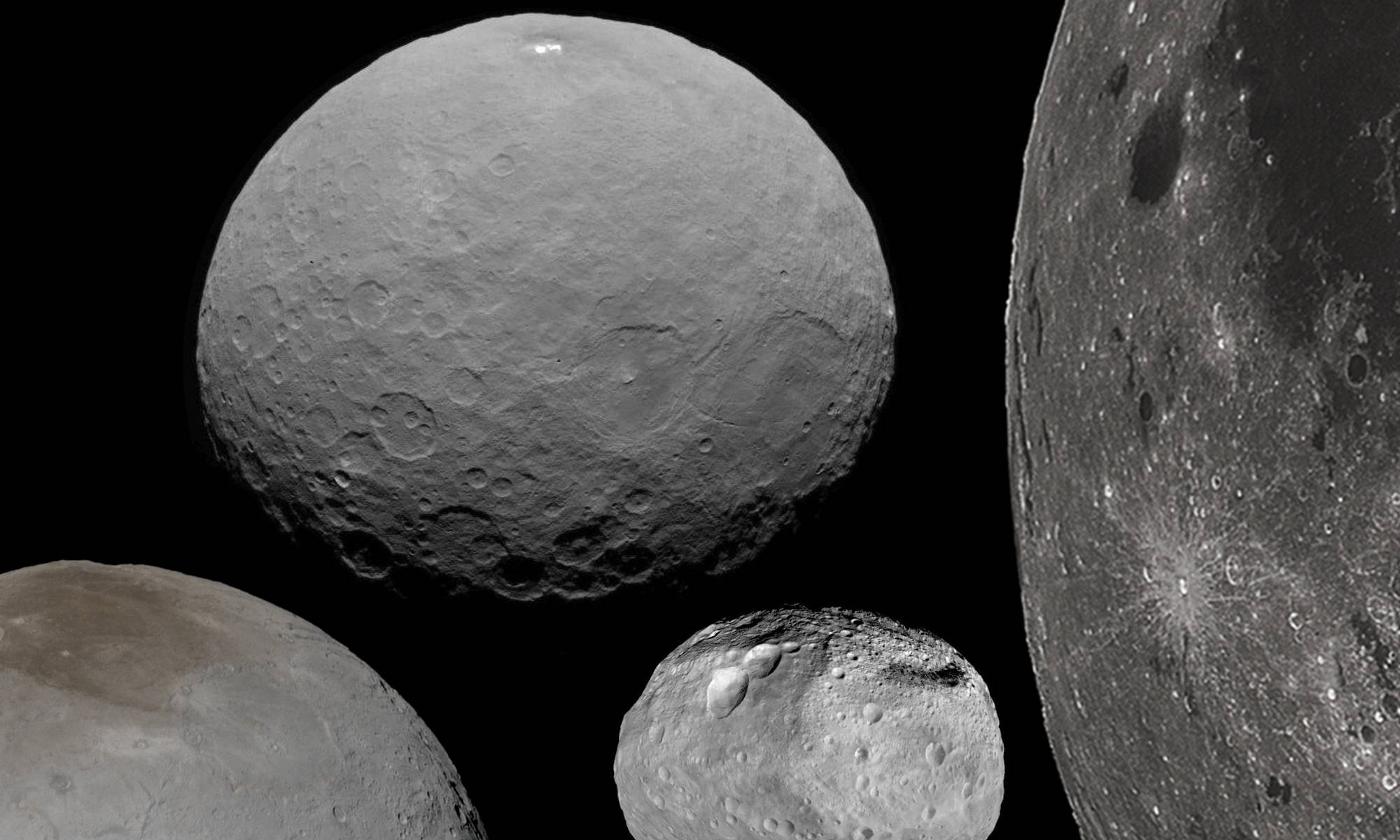
A composite view of portions of Charon, Ceres, Vesta and the Moon at scale
A composite view of Charon, Ceres, Vesta and the Moon at scale. 
    Credit for the original view of Charon: NASA/Johns Hopkins University Applied Physics Laboratory/Southwest Research 
    Institute. Credit for the original view of Ceres: NASA/JPL-Caltech/UCLA/MPS/DLR/IDA. Credit for the original view of 
    Vesta: NASA/JPL-Caltech/UCLA/MPS/DLR/IDA. Credit for the original view of the Moon: Wikipedia/Gregory H. Revera (CC 
    BY-SA 3.0). Montage credit: Marc Lafferre, 2022.

This composite view reveals, from left to right, Charon, Ceres, Vesta and the Moon at scale. Charon is the largest moon of Pluto. Ceres represents a dwarf planet located in the asteroid belt between Mars and Jupiter. Ceres is, by far, the largest body of the asteroid belt. Vesta represents a major asteroid of the asteroid belt. Our moon, the Moon, is significantly larger than Charon or Ceres. Charon had been imaged by the eyes of the New Horizons probe during its historic flyby of Pluto and Charon in 2015. Ceres and Vesta had been imaged with high details by the Dawn spacecraft from 2011 to 2018.

Credit for the original view of Charon: NASA/Johns Hopkins University Applied Physics Laboratory/Southwest Research Institute.
Credit for the original view of Ceres: NASA/JPL-Caltech/UCLA/MPS/DLR/IDA.
Credit for the original view of Vesta: NASA/JPL-Caltech/UCLA/MPS/DLR/IDA.
Credit for the original view of the Moon: Wikipedia/Gregory H. Revera (CC BY-SA 3.0).
Montage credit: Marc Lafferre, 2022.
(Natural intelligence)
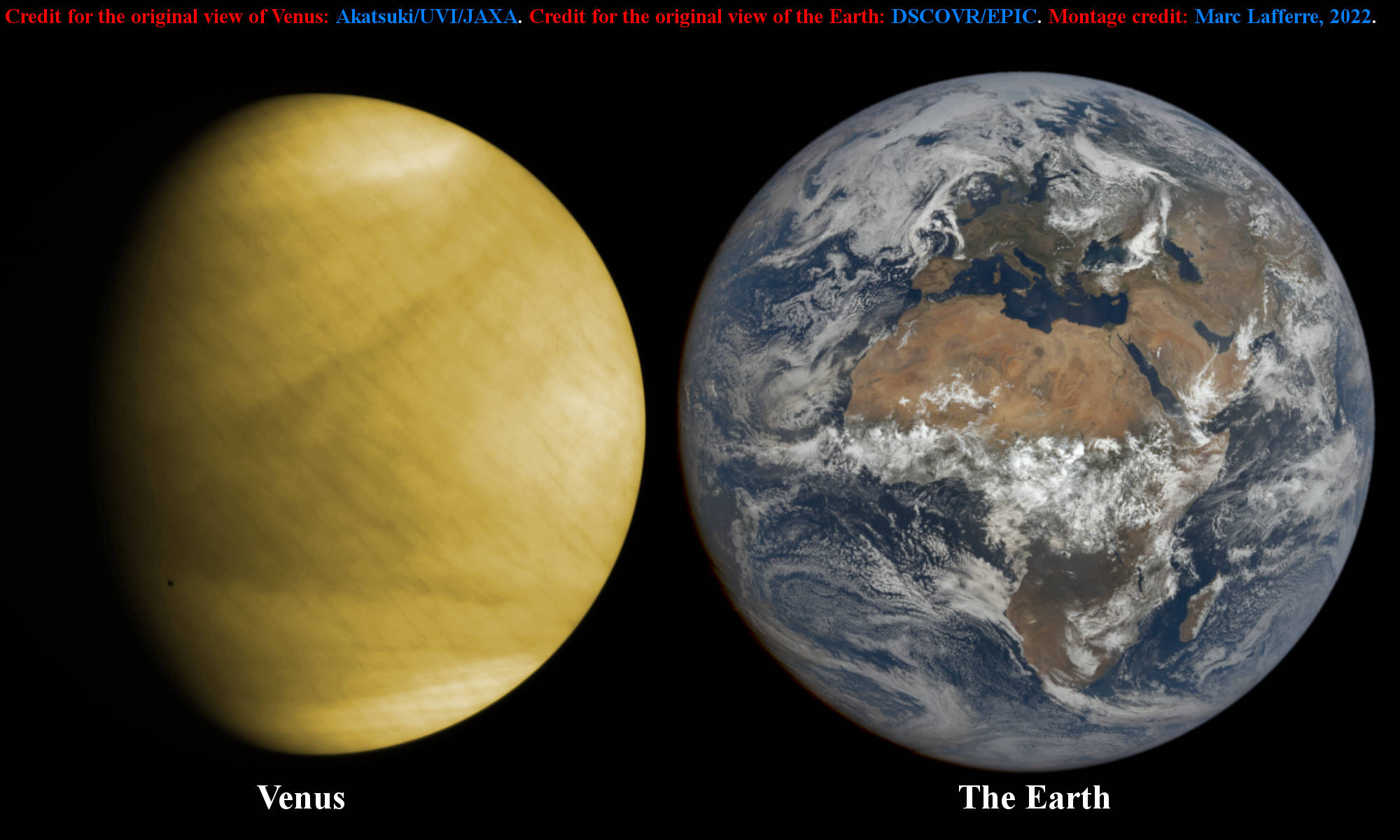
A composite view of Venus and the Earth at scale
A composite view of Venus and the Earth at scale. Credit 
    for the original view of Venus: Akatsuki/UVI/JAXA. Credit for the original view of the Earth: DSCOVR/EPIC. Montage 
    credit: Marc Lafferre, 2022.
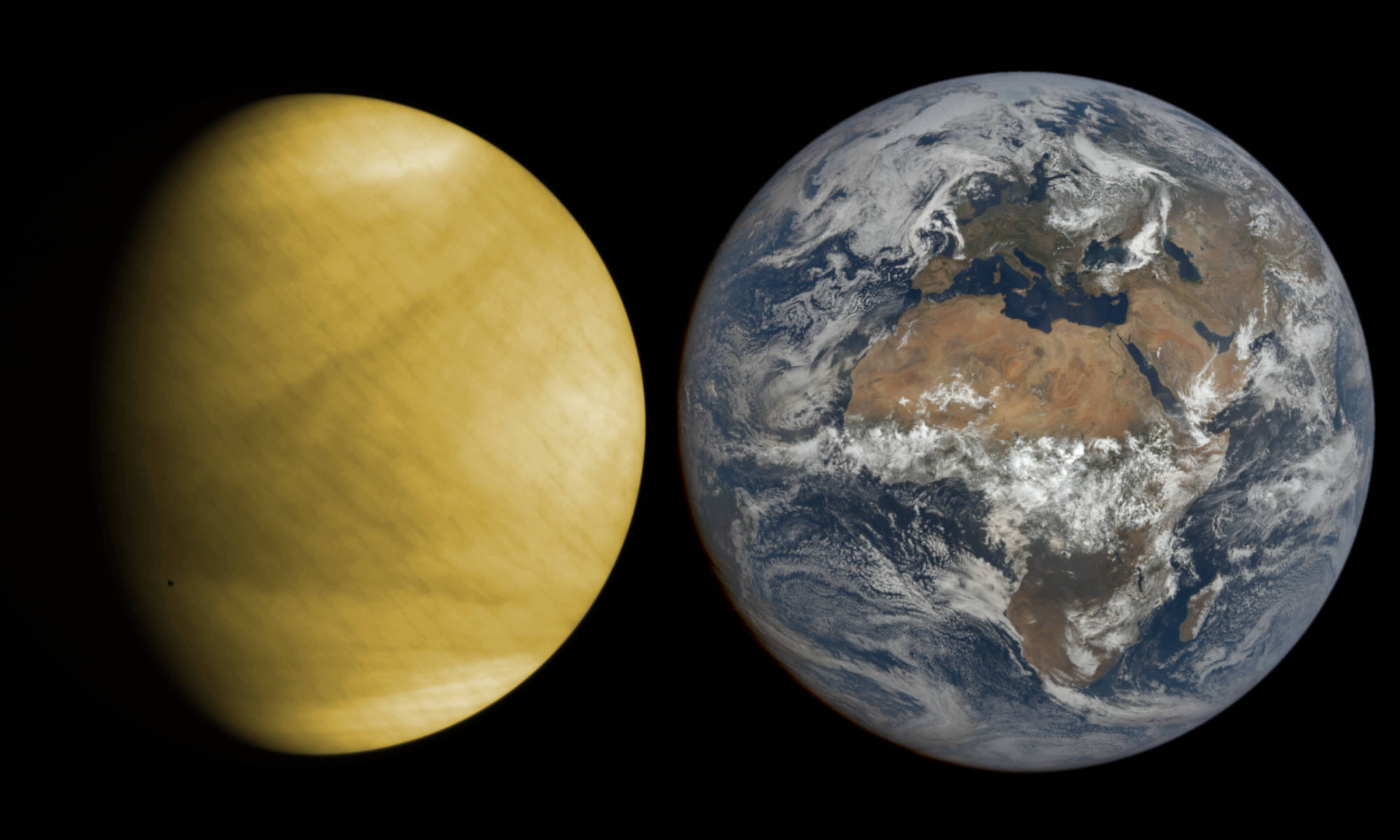
A composite view of Venus and the Earth at scale without 
    notes. Credit for the original view of Venus: Akatsuki/UVI/JAXA. Credit for the original view of the Earth: DSCOVR/EPIC. 
    Montage credit: Marc Lafferre, 2022.

This composite view reveals Venus and the Earth at scale. Venus is almost the same size as the Earth. We can't discern the surface of Venus from outer space in the visible spectrum due to opaque and dense atmosphere whose albedo is extremely high. The original view of the Earth was acquired with the EPIC instrument of the DSCOVR spacecraft on July 19, 2022. The original view of Venus was taken on November 10, 2021 from the Akatsuki spacecraft. The colors of Venus in this view are artificial.

Credit for the original view of Venus: Akatsuki/UVI/JAXA.
Credit for the original view of the Earth: DSCOVR/EPIC.
Montage credit: Marc Lafferre, 2022.
(Natural intelligence)
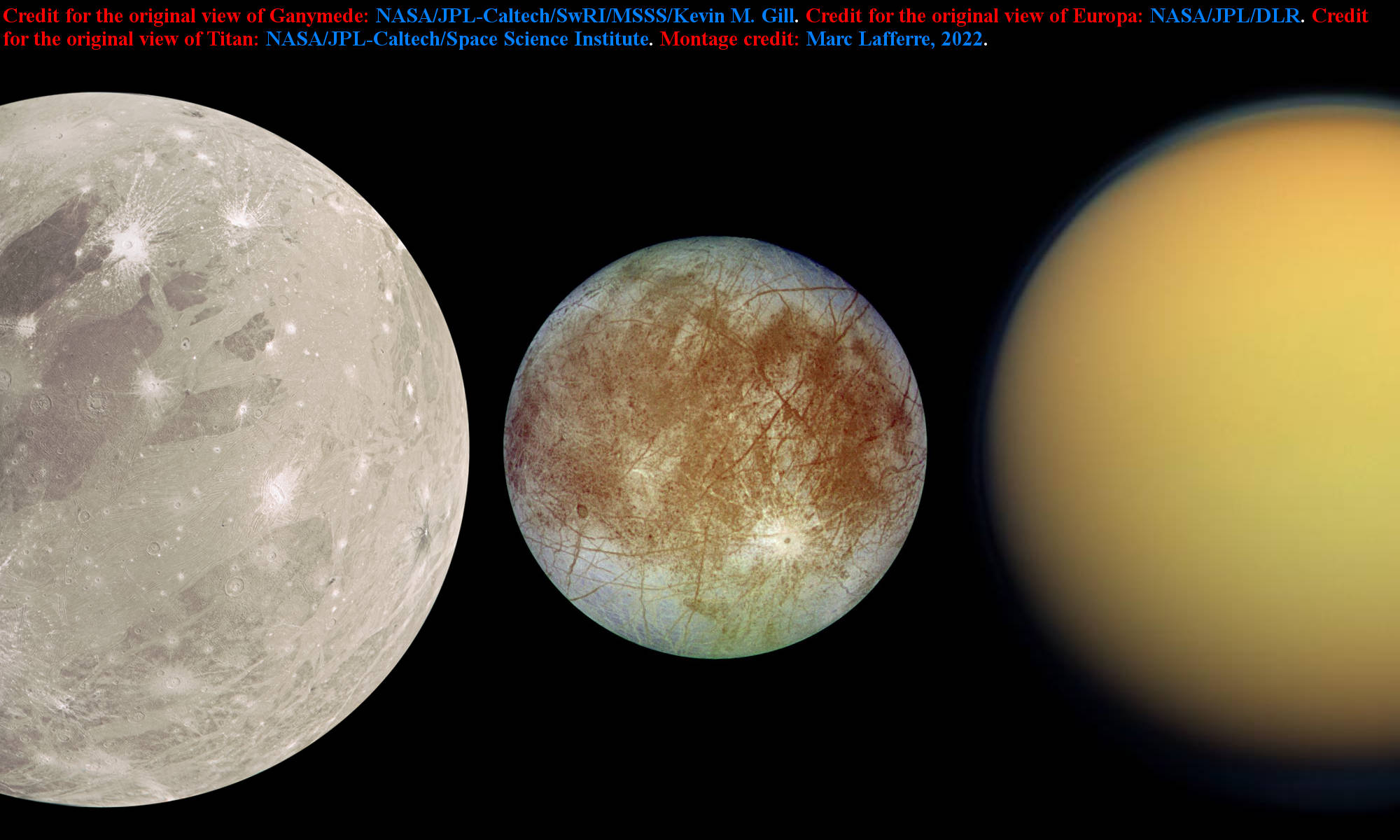
A composite view of Ganymede, Europa and Titan at scale
A composite view of a portion of Ganymede, Europa and 
    a portion of Titan at scale with notes. Credit for the original view of Ganymede: NASA/JPL-Caltech/SwRI/MSSS/Kevin 
    M. Gill. Credit for the original view of Europa: NASA/JPL/DLR. Credit for the original view of Titan: 
    NASA/JPL-Caltech/Space Science Institute. Montage credit: Marc Lafferre, 2022.
A composite view of a portion of Ganymede, Europa and 
    a portion of Titan at scale without notes. Credit for the original view of Ganymede: NASA/JPL-Caltech/SwRI/
    MSSS/Kevin M. Gill. Credit for the original view of Europa: NASA/JPL/DLR. Credit for the original view of 
    Titan: NASA/JPL-Caltech/Space Science Institute. Montage credit: Marc Lafferre, 2022.

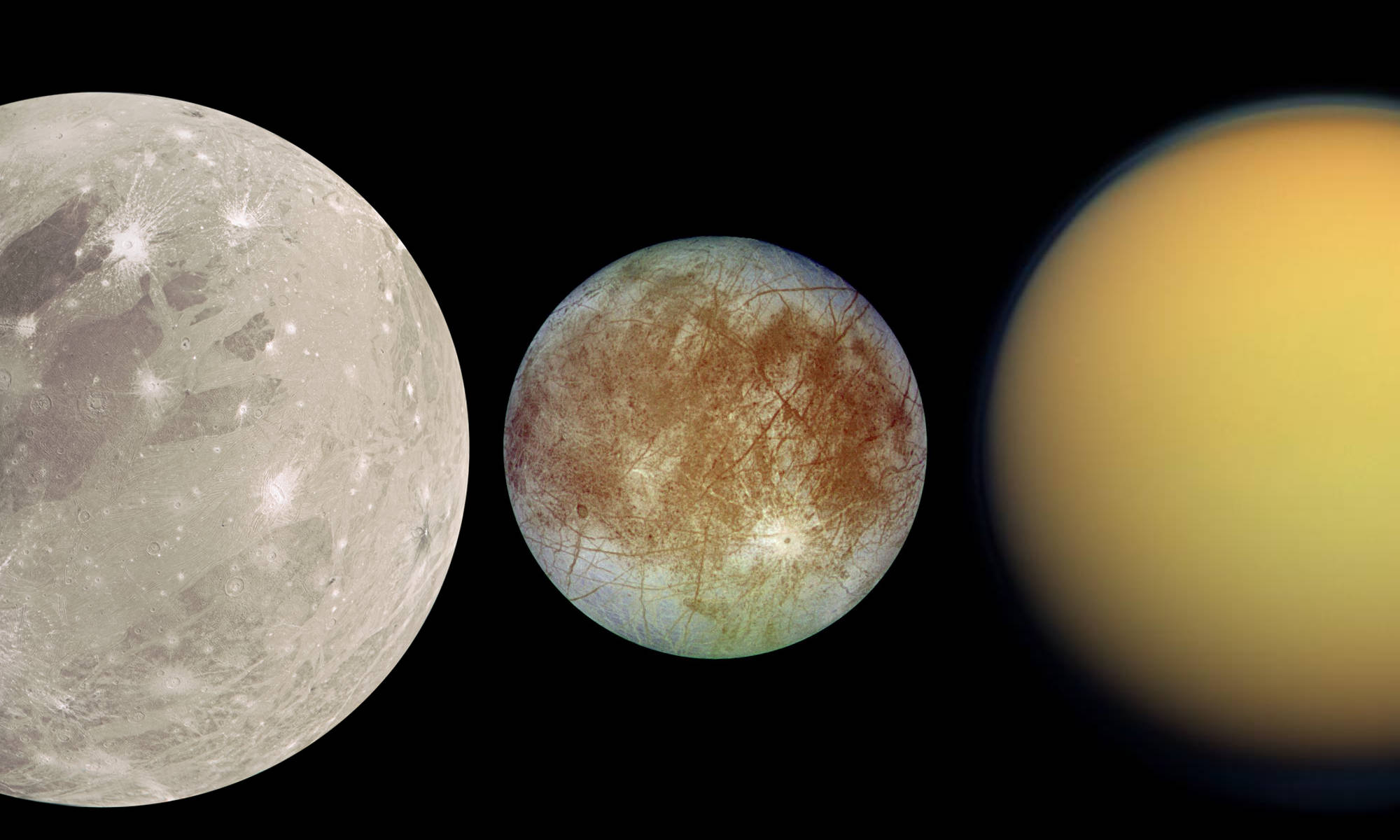
This composite image reveals a portion of Ganymede, Europa and a portion of Titan at scale. Ganymede represents the largest moon of Jupiter and the largest moon in the Solar System as well. Europa is another major moon of Jupiter. Titan represents the largest moon of Saturn and the second largest moon in the Solar System. Titan contains a deep and thick atmosphere that appears completely opaque from outer space in the visible spectrum. Surface features on the giant moon of Saturn can be discerned in infrared or near-infrared images. Europa has a surprising surface composed of multiple fractures that may be related to a subsurface ocean. Ganymede may also contain an unstable surface related to a subsurface ocean.

Credit for the original view of Ganymede: NASA/JPL-Caltech/SwRI/MSSS/Kevin M. Gill.
Credit for the original view of Europa: NASA/JPL/DLR.
Credit for the original view of Titan: NASA/JPL-Caltech/Space Science Institute.
Montage credit: Marc Lafferre, 2022.
(Natural intelligence)
Back to main page