Infographics 2024

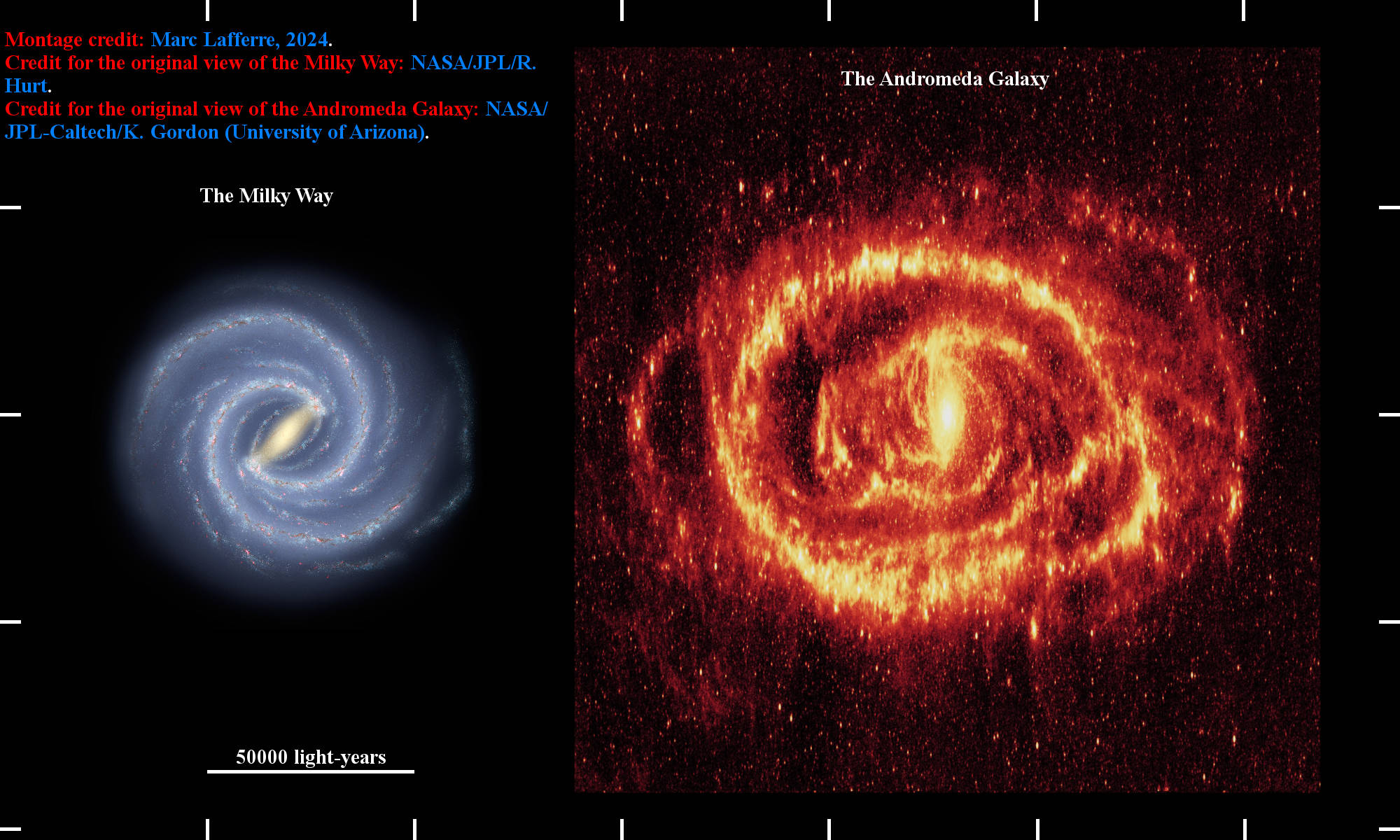
A polar view of our galaxy, the Milky Way, and a polar view of the Andromeda Galaxy at scale
A polar view of the Milky Way and a polar view of the 
    Andromeda Galaxy at scale. Credit for the original view of the Milky Way: NASA/JPL/R. Hurt. Credit for the original 
    view of the Andromeda Galaxy: NASA/JPL-Caltech/K. Gordon (University of Arizona). Montage credit: Marc Lafferre, 2024.

This composite image reveals a polar view of our galaxy, the Milky Way, as well as a polar view of the Andromeda Galaxy at scale. The polar views of both galaxies were generated on the basis of observations. The rotation axs of the Andromeda Galaxy appears inclined from the Earth so that it appears as an ovale but a 3D technique was mobilized to simulate its shape in a polar view. The original view of the Andromeda Galaxy was obtained thanks to data acquired from the Spitzer Space Telescope in the infrared spectrum.

Credit for the original view of the Milky Way: NASA/JPL/R. Hurt.
Credit for the original view of the Andromeda Galaxy: NASA/JPL-Caltech/K. Gordon (University of Arizona).
Montage credit: Marc Lafferre, 2024.
(Natural intelligence)
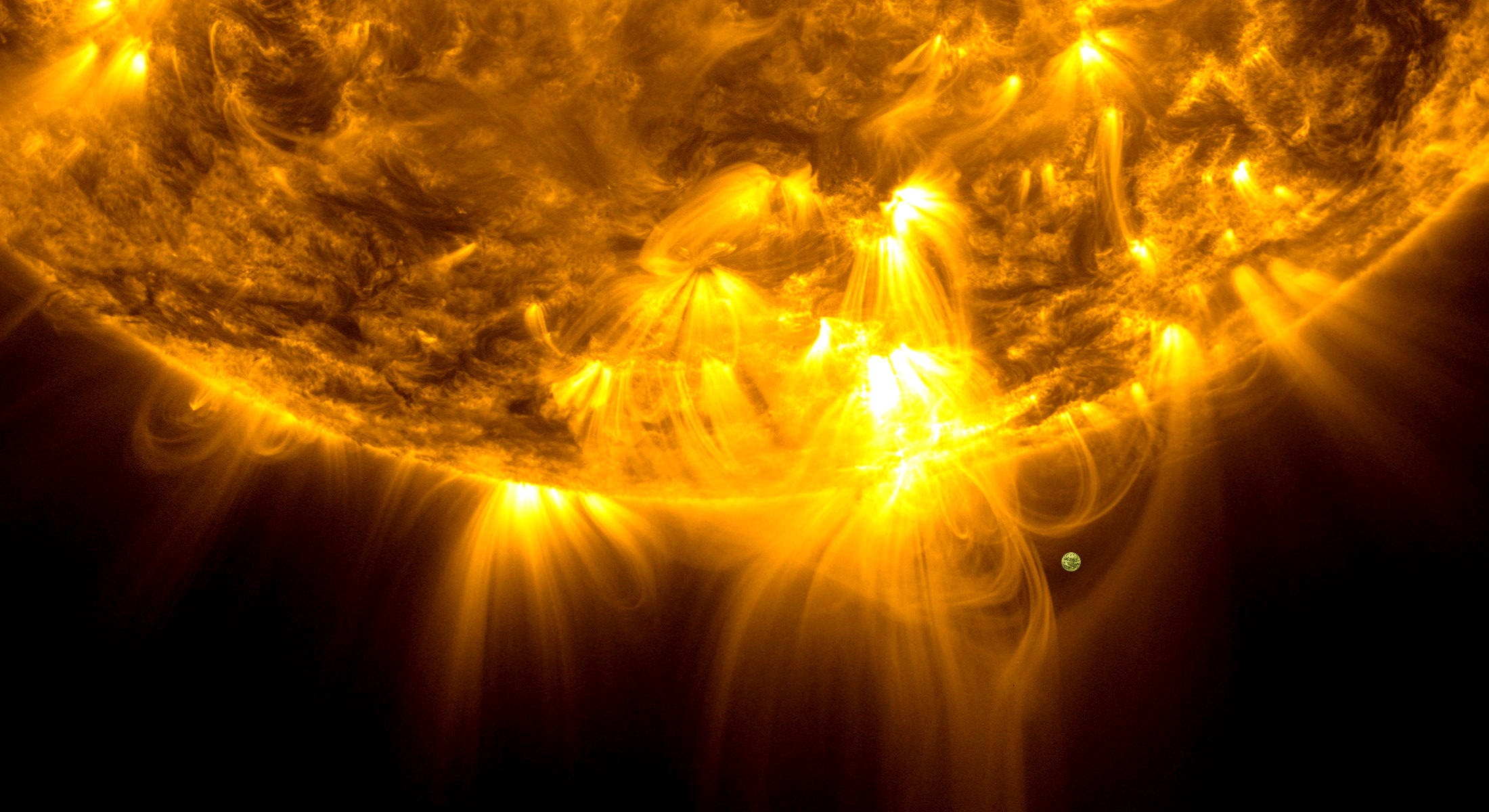
A composite view of a portion of the Sun obtained from the SDO spacecaft on July 24, 2024 with the Earth at scale
A composite view of a portion of the Sun acquired on 
    July 24, 2024 from the Solar Dynamics Observatory with the Earth at scale at the level of the solar flares. 
    Credit for the original view of the Sun: NASA/SDO. Credit for the original view of the Earth: DSCOVR/EPIC. 
    Montage credit: Marc Lafferre, 2024.

This composite view reveals a portion of the Sun acquired from the Solar Dynamics Observatory on July 24, 2024 with the AIA (Atmospheric Imaging Assembly) instrument in the spectrum of 17.1 nanometers as well as the Earth at scale at the level of the solar flares. The Sun whose apparent diameter from the Earth is approximately similar to the apparent diameter of the Moon from our planet is in fact much bigger than all the planets of the Solar System with a mean diameter that represents more than three times the mean distance between the Earth and the Moon.

Credit for the original view of the Sun: NASA/SDO.
Credit for the original view of the Earth: DSCOVR/EPIC.
Montage credit: Marc Lafferre, 2024.
(Natural intelligence)
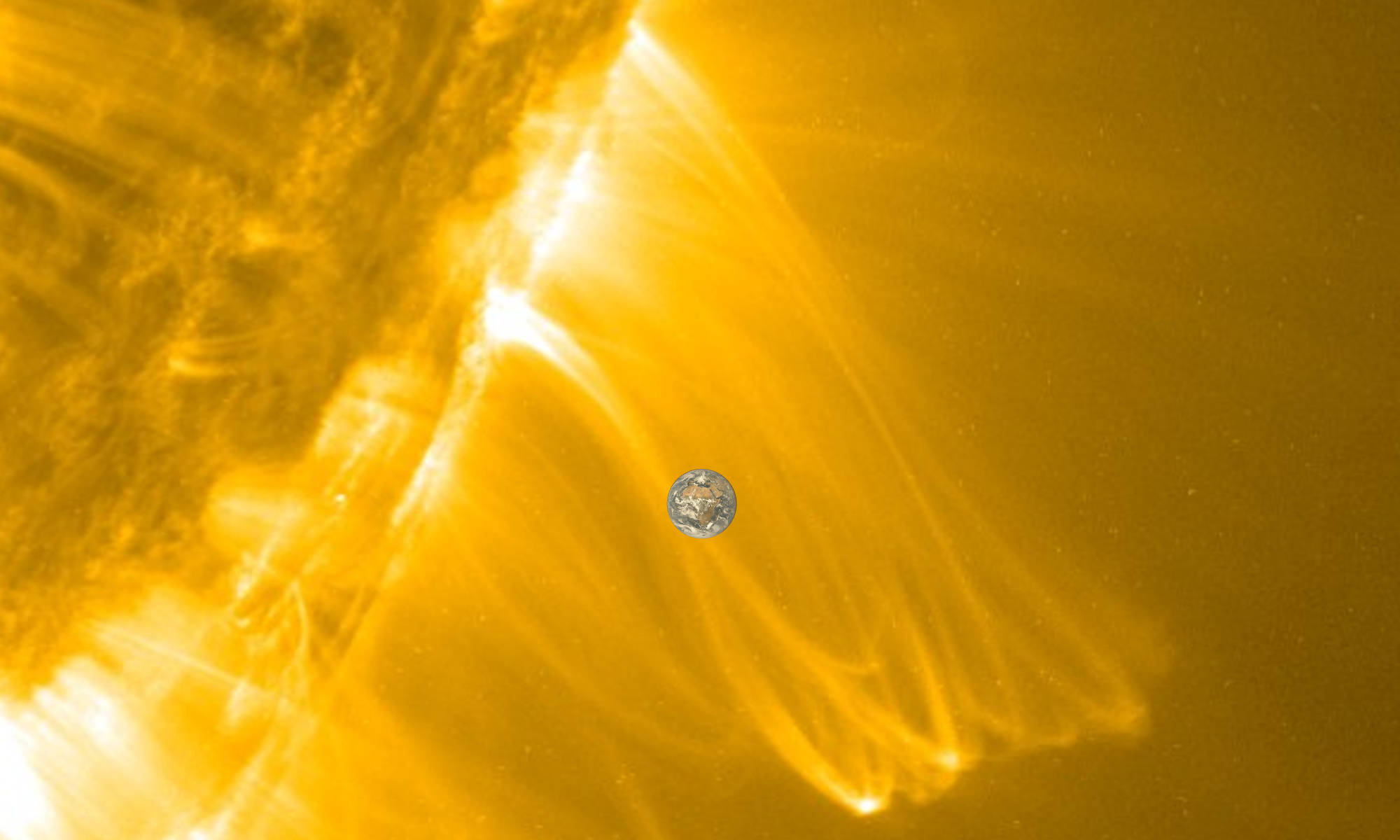
A composite view of a portion of the Sun obtained from the SDO spacecaft on September 14, 2024 with the Earth at scale in a field of solar flares
A composite view of a portion of the Sun acquired on 
    September 14 2024 from the Solar Dynamics Observatory with the Earth at scale in a field of solar flares. Credit 
    for the original view of the Sun: NASA/SDO. Credit for the original view of the Earth: DSCOVR/EPIC. 
    Montage credit: Marc Lafferre, 2024.

This composite view reveals a portion of our star, the Sun, unveiling multiple solar flares extending over astronomical distances and the Earth at scale in a field of solar flares. The original image of the Sun was obtained with the AIA instrument of the Solar Dynamics Observatory. The Sun was observed in the spectrum of 17.1 nanometers. The original image of the Earth was obtained with the EPIC instrument of the DSCOVR spacecraft on September 13, 2024. The Sun represents an "ocean" of magnetic fields that influence the trajectory of the solar flares.

Credit for the original view of the Sun: NASA/SDO.
Credit for the original view of the Earth: DSCOVR/EPIC.
Montage credit: Marc Lafferre, 2024.
(Natural intelligence)
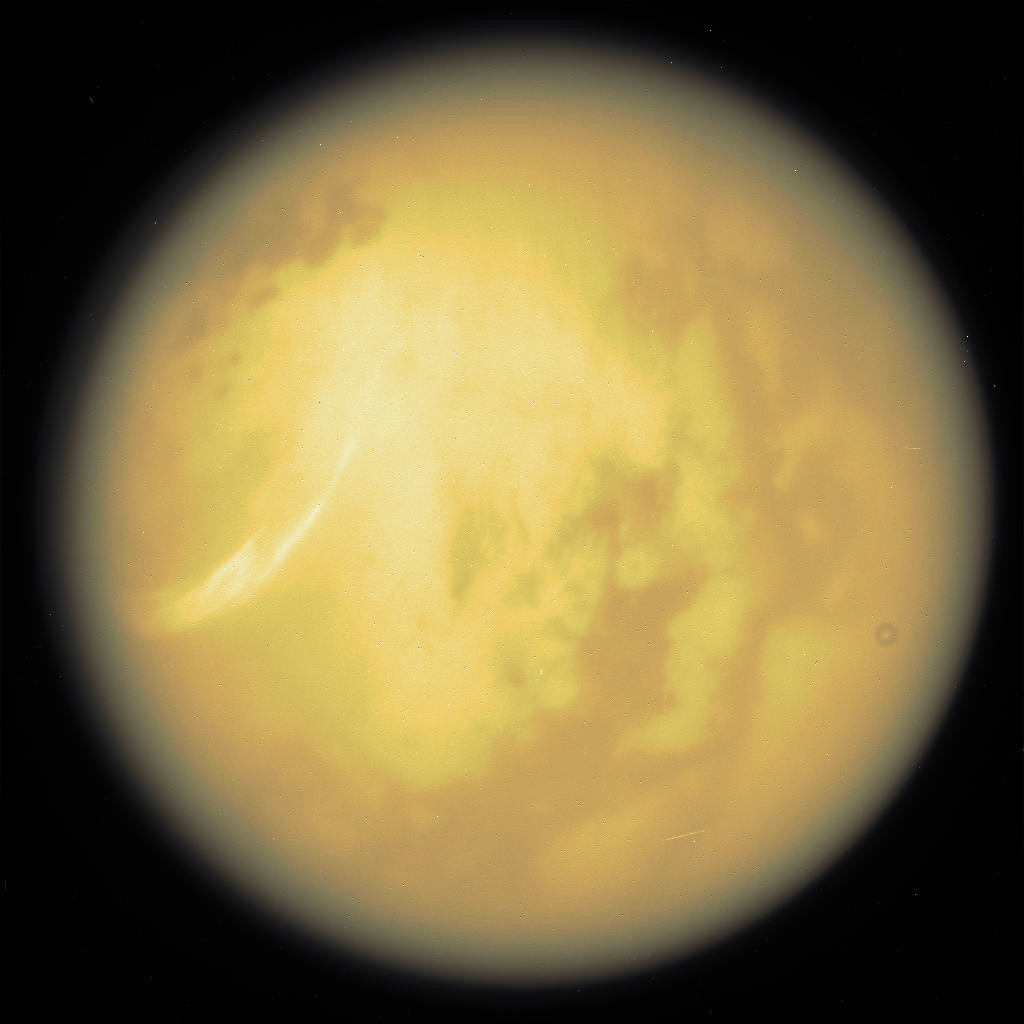
A colorized view of Saturn's largest moon Titan based on data acquired from the Cassini orbiter on March 21, 2017
A colorized view of Titan generated on the basis of data acquired 
    from the Cassini orbiter on March 21, 2017. Credit for the original view: NASA/JPL-Caltech/Space Science Institute. 
    Montage credit: Marc Lafferre, 2024.

This colorized image reveals Saturn's largest moon Titan. The original image whose file name is N00278453.jpg was acquired with the Narrow Angle Camera of the Cassini orbiter on March 21, 2017. The original view was taken by mobilizing the CL1 filter and the CB3 filter. The pools found in the high latitudes of the northern hemisphere of the giant moon can be clearly discerned. One can also notice elongated clouds.

Credit for the original view: NASA/JPL-Caltech/Space Science Institute.
Montage credit: Marc Lafferre, 2024.
(Natural intelligence)

Back to main page