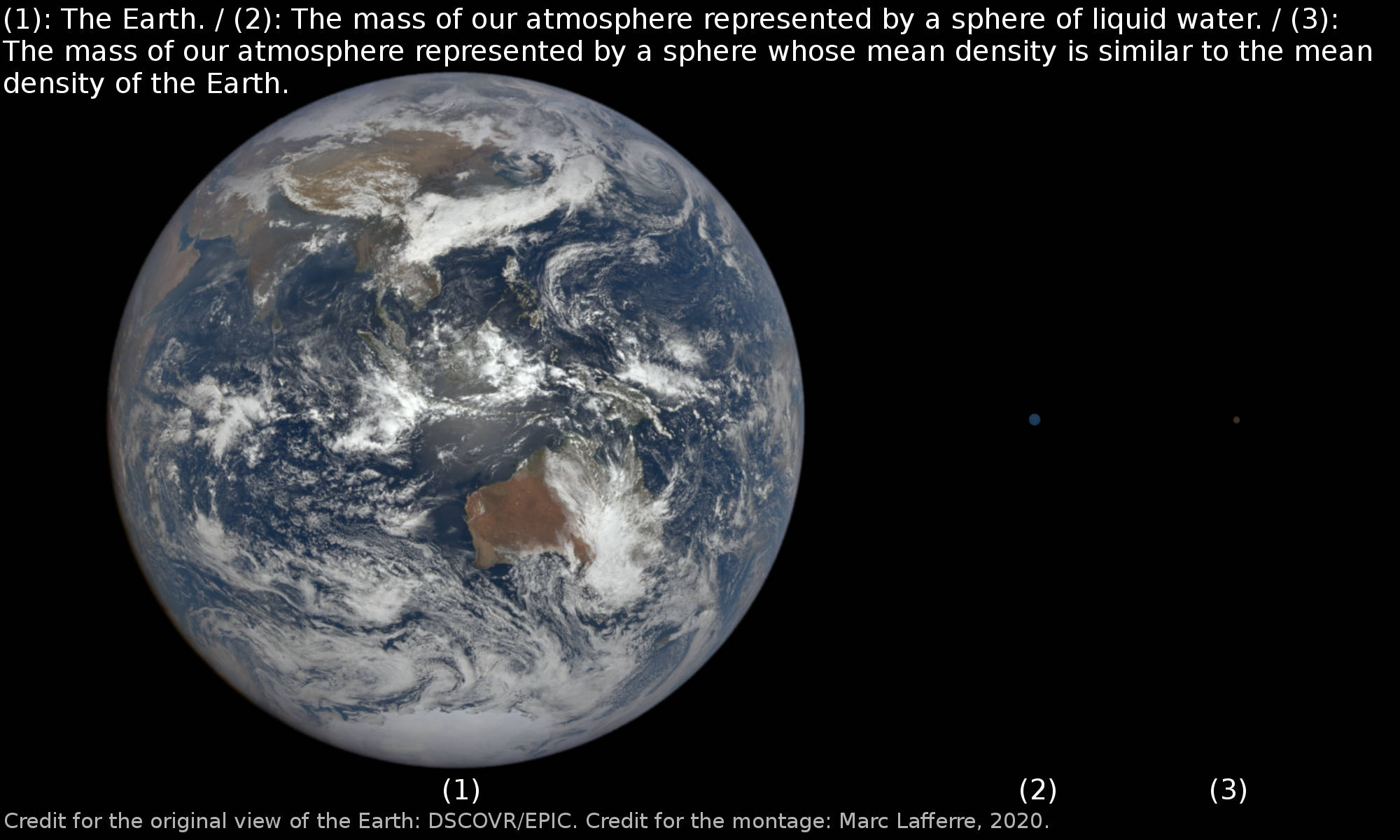
Venus and the Earth look alike in terms of size and mean density. That's why we call Venus our sister planet. Yet, the environment of Venus is extremely different at sea level. The atmosphere of Venus has nothing to do with the atmosphere of the Earth in terms of composition or in terms of dynamics. The atmosphere of Venus is much heavier than the atmosphere of the Earth. At sea level on Earth, the atmospheric pressure is around 1013 hectopascals, 1013 millibars or 1.013 bars but on the surface of Venus, the atmospheric pressure is much higher with a level around 92 bars (92000 millibars or 92000 hectopascals). How can we explain that huge difference for worlds that look alike in terms of mass or mean density ?
At first sight, the strange atmosphere of Venus clearly appears to be a paradox because we could have expected to discover an environment that looks like the environment of the Earth to a certain extent. Yet, the environment of Venus is extremely different from the typical environment of the Earth at sea level in terms of mean density, atmospheric pressure and composition. The air at sea level on the Earth is dominated by molecular nitrogen (around 78 percent of the composition) with a relatively significant concentration of oxygen (around 21 percent of the composition). By contrast, at the level of the surface of Venus, the air is dominated by carbon dioxide with a concentration representing around 96.5 percent of the global composition. Molecular nitrogen is also present at the level of the surface of Venus but it only represents around 3.5 percent of the global composition.
Where are the oxygen molecules in the atmosphere of Venus ? Is there water in the atmosphere of Venus ? Are there clouds of water in the atmosphere of Venus ? Surprisingly, the configuration of the atmosphere of Venus is extremely different from the configuration of the atmosphere of the Blue Planet because the atmosphere of Venus is extremely dry with an extremely limited concentration of water in the atmosphere. We must keep in mind that the mean surface temperature on Venus evolves around 464 degrees Celsius, 867 degrees Fahrenheit or 737 Kelvin. By contrast, the mean surface temperature at sea level on Earth is much lower evolving around 15 degrees Celsius. That significant difference is closely related to the greenhouse effect engendered by the atmosphere of Venus that traps infrared light and that fuels the environmental hell.
Venus evolves closer to the Sun than the Earth so that it receives a higher amount of radiations from the Sun. The amount of energy received from the Sun follows the inverse square law. If the distance from the Sun is twice higher, the level of energy received from the Sun will be 4 times lower (2² times lower). At the level of the Earth, the amount of energy received from the Sun is around 1361 joules per square meter per second or 1361 watt per square meter. At the level of Venus, at the distance from the Sun that represents 108 210 000 kilometers or 0.723332 Astronomical Units, the level of energy received from the Sun is much higher with a level of around 2600 watt per square meter or 2600 joules per square meter per second. On the basis of the type of greenhouse effect we observe on Earth, we could have expected a mean surface temperature of around 54 degrees Celsius (around 129 degrees Fahrenheit or around 327 Kelvin) on Venus but that is far from being the case due to that extraordinary greenhouse effect.
In the past, some researchers had imagined a type of tropical environment on Venus with a high level of humidity and high environmental temperatures but that's not the reality of Venus. Seas or oceans of liquid water can't be envisaged on Venus due to extremely high environmental temperatures that allow the presence of liquid lead or liquid tin. The atmosphere of Venus appears completely opaque from outer space in the visible spectrum due to clouds of sulfuric acid (H2SO4) in particular. Instead of the typical clouds of water we have on Earth, the clouds of Venus are dominated by sulfuric acid. The rotation of Venus is extremely slow but the movement of its atmosphere is remarkably dynamic with a super-rotation phenomenon. It takes no less than 243 Earth days for Venus to perform a complete rotation but it takes only 4 days for the upper part of the troposphere of that world to perform a complete rotation.
The mass of Venus is lower than the mass of the Earth so that it would be less likely to retain the same amount of volatiles at the same distance from the Sun as the Earth. The higher the mass of the planetary body, the easier it will be for that planetary body to retain some volatiles or to retain an atmosphere at the same distance from the Sun. The closer to the Sun the planetary body evolves, the easier it will be for the volatiles or the atmosphere of that planetary body to escape into outer space. That's what the English astronomer James Jeans had shown with the process known as Jeans Escape. Venus is approximately 19 percent lighter than the Earth so that the planetary body is less likely to retain its volatiles or its atmosphere. The atmospheric escape is in fact closely related to molecular kinetic energy and to gravitational energy. The molecule will tend to escape into outer space if it is moving faster than the escape velocity of the planetary body.
Venus is lighter than the Earth and it receives more energy from the Sun due to a lower orbit around the Sun. Therefore, at first sight, Venus should have a thinner atmosphere than the Earth because it is lighter and because it also evolves closer to the Sun receiving more energy implying more dynamic volatiles or more dynamic molecules in the atmosphere. Yet, Venus contains a heavy atmosphere that is much heavier than the atmosphere of our planet. That seems to be a paradoxical phenomenon at first sight ! In fact, we must extend the reasoning to the liquid areas and the Earth contains a significant amount of liquids on its surface which is not the case on the surface of Venus where the air is extremely dry. Almost 71 percent of the surface of the Earth is covered in oceans or seas of liquid water. The liquids must be taken into account in the analytical work. We must compare the mass of the atmosphere of Venus with the mass of the atmosphere and of the hydrosphere of the Earth.
By comparing the mass of the atmosphere of the twin of our planet with the mass of our atmosphere and of our hydrosphere, we will be in a position to determine whether there are more volatiles on the Earth or on Venus. The weight or the atmospheric pressure on the surface of Venus are so high that it is similar in terms of pressure to the environment at a depth of about 900 meters or about 3000 feet beneath the sea level on Earth. Let's calculate the mass of the atmosphere of Venus ! If the mean surface pressure on the surface of Venus is around 92 bars, one can deduce the mass of the atmosphere on a perfect sphere whose diameter is 12103.6 km. The surface area on which the weight of the atmosphere is applied can be calculated with the formula 4*Pi*r² in which r represents the radius of the planetary body. Therefore, the surface area of Venus represents approximately 460 234 317 km². That value is obtained with the following calculation: 4*Pi*(6051.8 km)² = 460 234 316.7 km².
We know that on each square meter on Venus, there is an atmopheric pressure of around 92000 millibars or 9 200 000 Pascals that is to say 9 200 000 Newton per square meter. The mass of the atmosphere per square meter can be deduced by dividing 9 200 000 Pascal by the gravity of the planetary body that is equal to 8.87 meters per second squared. Thus, the mass of the atmosphere of Venus per square meter is around 1 037 204 kg. That value is obtained with the following calculation: 9 200 000 Pascals / 8.87 meters per second squared = 1 037 204.059 kg. One can obtain the global mass of the atmosphere by multiplying the surface area of the perfect sphere by the mass of the atmosphere applied to each square meter. The mass of the atmosphere of Venus represents around 4.7736 * 10^20 kg. That value is obtained with the following calculation: 460 234 316.7 km² * 1000 meters * 1000 meters * 1 037 204.059 kg = 4.7736 * 10^20 kg. Let's note here that we have converted the surface area in kilometers into the surface area in meters by multiplying the surface area in kilometers by 1 000 000 meters.
What is the weight or the mass of the atmosphere of the Earth ? The mass of the atmosphere of the Earth is estimated to represent around 5.1480 * 10^18 kg. Therefore, the mass of the atmosphere of our planet only represents about 1.08 percent of the mass of the atmosphere of Venus. That value is obtained with the following calculation: (5.1480 * 10^18 kg) / (4.7736 * 10^20 kg) * 100 = 1.078431373. One can also say that the mass of the atmosphere of Venus is about 92.73 times higher than the mass of the atmosphere of the Earth. That value is obtained with the following calculation: 4.7736 * 10^20 kg / 5.1480 * 10^18 kg = 92.72727273. The contrast of atmospheric mass between the Earth and our twin Venus is clearly impressive and surprising at first sight but we must also consider the weight of the hydrosphere of the Earth in our analysis.
What is the weight or the mass of the hydrosphere of the Earth ? The volume of the hydrosphere of our planet is evaluated at 1386 million cubic kilometers. Let's assume that the mean density of liquid water is 1 gram per cubic centimeter or 1000 kilograms per cubic meter. The mean density of liquid water per cubic kilometer is 1000 000 000 000 kilograms. That value is obtained with the following calculation: 1000 kilograms per cubic meter * 1000 meters * 1000 meters * 1000 meters = 1000 000 000 000 kilograms per cubic kilometer. One can calculate the evaluated mass of the hydrosphere of the Earth by multiplying the volume of our hydrosphere by its mean density. We obtain a mass of about 1.386 * 10^21 kg for our hydrosphere. That value is obtained with the following calculation: 1 386 000 000 cubic kilometers * 1000 000 000 000 kilograms = 1.386 * 10^21 kilograms.
The evaluated mass of our hydrosphere represents about 269 times the mass of our atmosphere. That value is obtained by dividing the mass of our hydrosphere by the mass of our atmosphere. Here is the calculation: 1.386 * 10^21 kg / 5.1480 * 10^18 kg = 269.2307692. Now, we are in a position to compare the mass of the volatiles of the Earth to the mass of the volatiles on Venus. The mass of the volatiles of the Earth can be obtained by adding the mass of the hydrosphere of the Earth to the mass of its atmosphere. The mass of the volatiles of our planet is evaluated at about 1.39 * 10^21 kilograms. That value is obtained with the following calculation: 5.148 * 10^18 kg + 1.386 * 10^21 kg = 1.391148 * 10^21 kg. That mass must be compared to the mass of the atmosphere of Venus that represents about 4.7736 * 10^20 kg. In fact, there are almost 3 times more volatiles on the Earth than on Venus, around 2.91 times more volatiles to be precise. That value is obtained with the following calculation: 1.391148 * 10^21 kg / 4.7736 * 10^20 kg = 2.914253394.
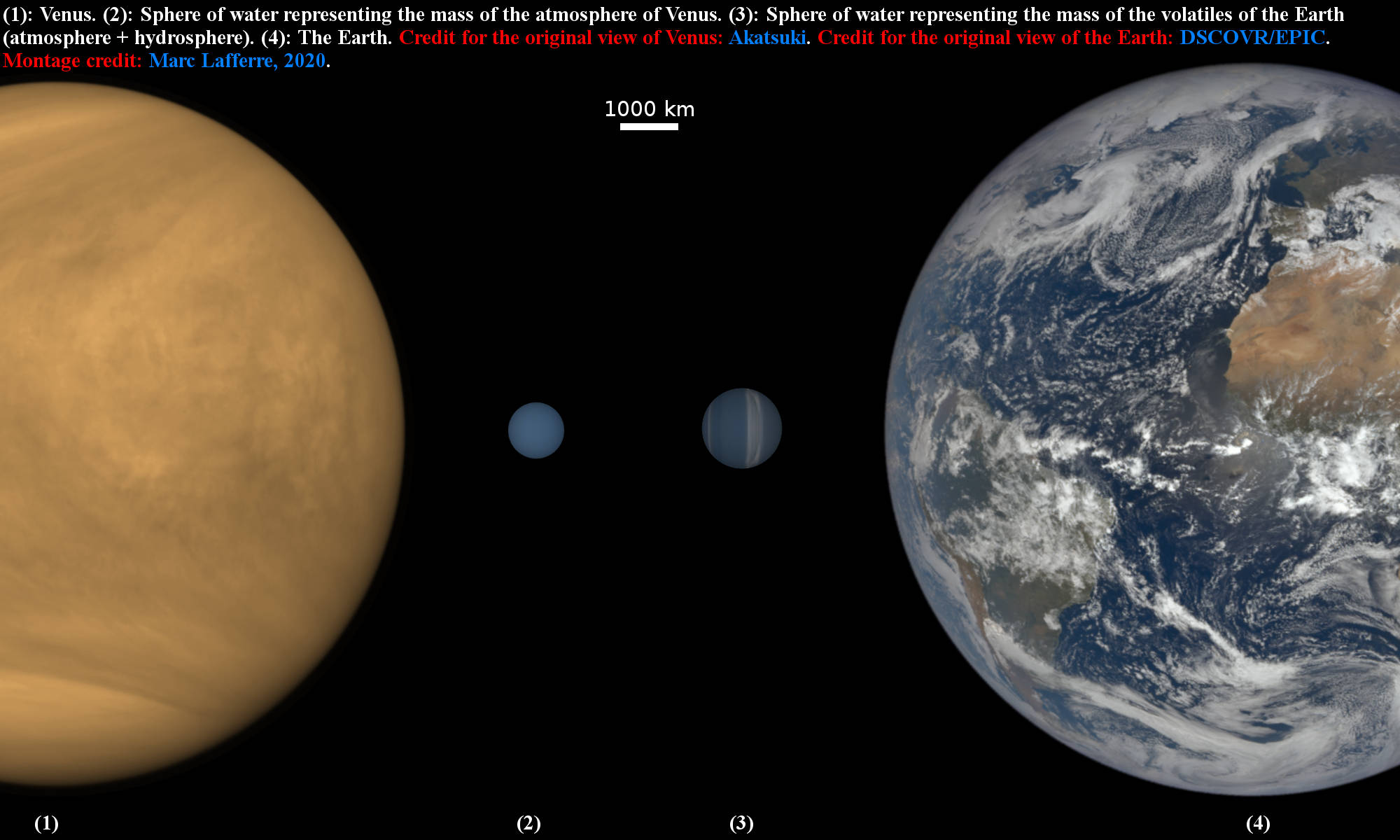
The equivalent of the mass of the atmosphere of Venus could be represented by a perfect sphere of water whose diameter is around 970 kilometers because its total mass would represent the equivalent of the mass of the atmosphere of Venus that is to say 4.7736 * 10^20 kg. That value can be obtained with the following calculation: (4/3) * Pi * (969.6496858 km / 2)^3 * 1 000 000 000 000 kg per cubic kilometer = 4.7736 * 10^20 kg.
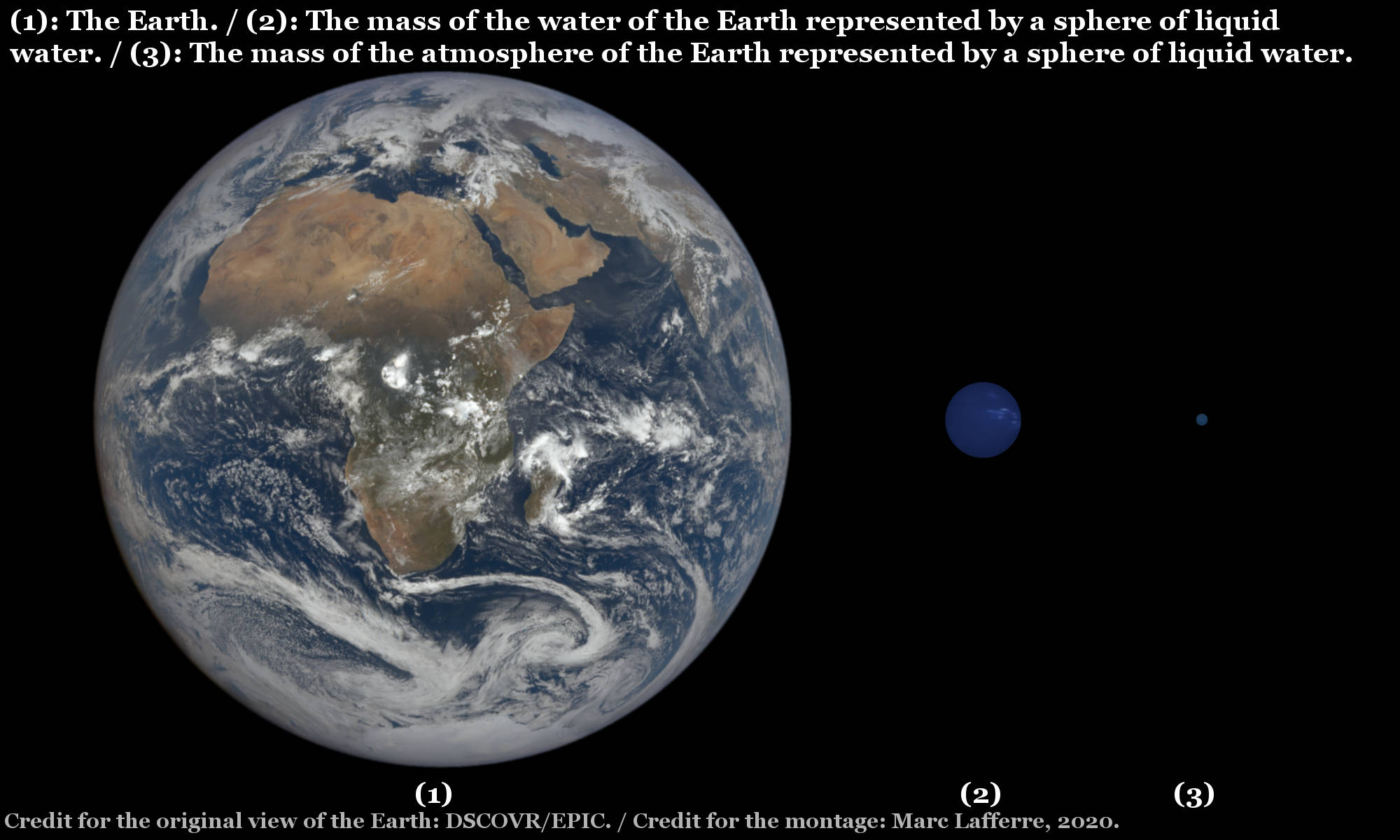
The equivalent of the mass of the atmosphere of the Earth could be represented by a perfect sphere of water whose diameter is around 214.23 kilometers because its total mass would represent the equivalent of the mass of the atmosphere of the Earth that is to say 5.148 * 10^18 kg. That value can be obtained with the following calculation: (4/3) * Pi * (214.2298442 km / 2)^3 * 1 000 000 000 000 kg per cubix kilometer = 5.148 * 10^18 kg.
The equivalent of the mass of the hydrosphere of the Earth could be represented by a perfect sphere of water whose diameter is around 1383.32 kilometers because its total mass would represent the equivalent of the mass of the hydrosphere of the Earth that is to say 1.386 * 10^21 kg. That value can be obtained with the following calculation: (4/3) * Pi * (1383.316433 km / 2)^3 * 1 000 000 000 000 kg per cubic kilometer = 1.386 * 10^21 kg.
The equivalent of the mass of the volatiles of the Earth could be represented by a perfect sphere of water whose diameter is around 1385.03 kilometers because its total mass would represent the equivalent of the cumulated mass of the hydrosphere and of the atmosphere of the Earth that is to say 1.391148 * 10^21 kg. The value of 1.391148 * 10^21 kg is obtained with the following calculation: 5.148 * 10^18 kg + 1.386 * 10^21 kg = 1.391148 * 10^21 kg. That value can be obtained with the following calculation: (4/3) * Pi * (1385.0269939208 / 2)^3 * 1 000 000 000 000 kg per cubic kilometer = 1.391148 * 10^21 kg.
The table below reveals key data regarding the characteristics of the Earth and Venus.
| Type of data | Venus | The Earth |
|---|---|---|
| Mean diameter | 12103.6 km | 12742 km |
| Planetary mass | 4.86731 * 10^24 kg | 5.97217 * 10^24 kg |
| Relative mass of the planet (base 1 The Earth) | 0.814998568 (*) | 1 |
| Relative mass of the planet (base 1 Venus) | 1 | 1.22699602 (*) |
| Atmospheric pressure at sea level | 93 bar | 1.01325 bar |
| Atmospheric composition | Carbon dioxide (96.5%), nitrogen (3.5%)... | Nitrogen (78.08%), oxygen (20.95%)... |
| Semi-major axis | 0.723332 AU | 1 AU |
| Mean surface temperature at sea level | 464 degrees Celsius (867°F or 737K) | 15 degrees Celsius (59°F or 288.15K) |
| Evaluated mass of the atmosphere | 4.7736 * 10^20 kg (*) | 5.1480 * 10^18 kg (*) |
| Relative mass of the atmosphere (base 1 for the Earth) | 92.73 (*) | 1 |
| Relative mass of the atmosphere (base 1 for Venus) | 1 | 0.01078431373 (*) |
| Evaluated mass of the hydrosphere | Unknown | 1.386 * 10^21 kg (*) |
| Ratio mass hydrosphere / mass atmosphere | Unknown | 269.2307692 (*) |
| Ratio mass atmosphere / mass hydrosphere | Unknown | 0.003714286 (*) |
| Evaluated mass of the volatiles | 4.7736 * 10^20 kg (*) | 1.391148 * 10^21 kg (*) |
| Relative mass of the volatiles (base 1 for Venus) | 1 | 2.914253394 (*) |
| Relative mass of the volatiles (base 1 for the Earth) | 0.34314106 (*) | 1 |
| Diameter of the sphere of water representing the mass of the atmosphere | 969.6496858 km (*) | 214.2298442 km (*) |
| Diameter of the sphere of water representing the mass of the hydrosphere | Unknown | 1383.316433 km (*) |
| Diameter of the sphere of water representing the mass of the volatiles | 969.6496858 km (*) | 1385.0269939208 km (*) |
(*): Data produced via calculations in this research work.
At first sight, we may think that Venus is richer in volatiles than the Earth and that the presence of a heavier atmosphere on Venus than on Earth is not in line with what we could have expected on the basis of the principle of the Jeans escape. This resarch work shows that the Earth contains, in fact, more volatiles than Venus thanks to its hydrosphere that represents much more than our atmosphere in terms of mass. There are no seas or oceans of liquid water on the surface of Venus and the surface of the Earth is dominated by oceans whose depth can reach almost 11 kilometers. We show that the cumulated mass of our atmosphere and of our hydrosphere represents almost 3 times the mass of the huge atmosphere of Venus. That reality appears logical due to the lower mass of Venus and due to the higher level of energy received from the Sun at the level of the orbit of Venus.
Credit for the research work: Marc Lafferre, 2020/2026.
(Natural intelligence)